Learn how AI smart mattress sleep monitoring tracks heart rhythm, breathing, and movement for better rest. Explore DeRUCCI options today.
By DeRUCCI Team 2026-06-23 7 min read
How AI Smart Mattresses Monitor Sleep Health
Waking up tired after eight hours in bed does not always mean the night was too short. In daily use, the problem may sit in the details: breathing rhythm that becomes uneven, frequent small position changes, pressure points around the shoulder or hip, or a mattress that keeps the same feel even as the body shifts through the night. That is why the question of how an AI smart mattress monitors sleep health matters for households comparing comfort, wellness features, and connected home products. DeRUCCI approaches this category as a closed-loop sleep system: the mattress reads sleep-related signals, interprets patterns over the night, and adjusts support so the sleeper is not left changing settings manually at 2 a.m.
What Is AI Smart Mattress Sleep Monitoring?
AI smart mattress sleep monitoring means the bed follows nightly body signals, translates them into readable sleep patterns, and uses those findings to support more consistent rest. Instead of working only as a passive cushion, the mattress acts as a quiet sleep system that observes, learns from repeated use, and responds while the person is still asleep.
A conventional mattress asks the body to fit a fixed surface. An AI smart mattress changes that relationship. It monitors how the sleeper lies down, how breathing and heart rhythm behave during rest, and how pressure shifts when posture changes. The goal is not to push raw data onto the user every morning. The more useful goal is to turn signals that are usually invisible into practical context: Did sleep stay continuous? Did the body settle quickly after lying down? Were there repeated movements? Did deeper, restorative sleep remain stable for meaningful periods?
In DeRUCCI’s T11 PRO, this idea is organized through the SleepCare System and AI Tidal Algorithm 2.0. The process can be understood in three working steps. First, the mattress captures sleep-related signals through the bed surface. Second, the system analyzes those signals against sleep and ergonomics knowledge. Third, the support system responds through automatic comfort adjustment. In practice, the mattress is doing its work during the night, not simply presenting a report after the user wakes up and tries to reconstruct what felt wrong.
This framing matters because sleep health is rarely explained by one number. A useful system looks for repeated patterns: difficulty falling asleep, restless movement, irregular breathing rhythm, or support that does not match the body’s pressure points. The more consistently the mattress observes those signals across nights, the more useful the feedback becomes for understanding comfort, routine, and rest quality.
How Does Non-Contact Sleep Monitoring Work?
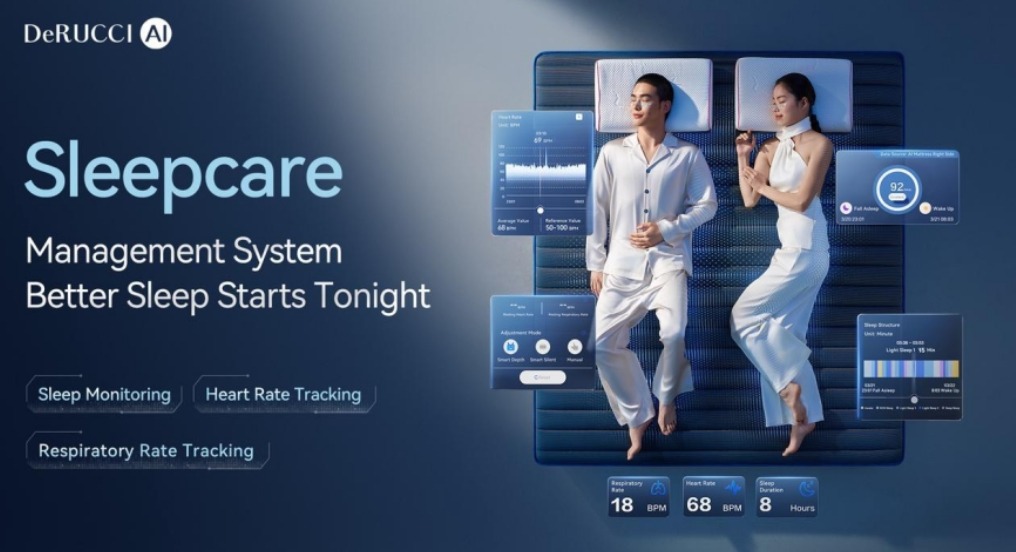
Non-contact sleep monitoring uses sensors built into the mattress to follow the body’s rhythm without requiring a watch, ring, or chest strap. The user lies down as usual, while the mattress reads movement, pressure, heart rhythm, and breathing patterns through the sleep surface.
The principle is easier to understand through the way small movements travel through a surface. Breathing, heartbeat, and body movement create subtle mechanical signals that can be detected through the bed. A smart mattress reads those signals, filters ordinary movement, and identifies patterns that are meaningful for sleep tracking.
For T11 PRO, DeRUCCI connects this approach with Harvard CPC, or cardiopulmonary coupling, within the SleepCare System. In plain terms, CPC looks at how breathing and heart rhythm move together during sleep. When those rhythms remain steady, rest often feels more settled. When they become irregular, the body may be spending more time in lighter or more interrupted sleep. The mattress does not require a wearable device because the signal is read through contact with the sleeping surface.
This is where user comfort becomes a practical issue rather than a small feature. Many people stop using sleep watches or rings because the device feels intrusive, needs charging, or adds another task to the bedtime routine. A mattress-based system removes that extra step. The user does not need to remember to wear or charge anything. The bed itself becomes the monitoring environment.
Overnight, the system can track heart rate trends, breathing rhythm, body movement, and sleep phases with an emphasis on whole-night continuity. The main benefit is not simply having more data. It is reducing guesswork. If someone often wakes up tired, the report may help show whether the night was repeatedly interrupted, whether deeper and more restorative sleep was limited, or whether movement increased after a certain point in the night.
What Sleep Health Metrics Can an AI Mattress Show?
An AI smart mattress can show daily sleep duration, breathing rhythm, heart rate trends, movement, and time spent in deep, restorative sleep. These metrics become more useful when reviewed across several nights, because sleep health is a pattern built over time rather than a final judgment from one night.
A daily sleep report gives the user a practical morning reference. Instead of relying only on the question of whether the night felt good, the user can look at signals such as total rest time, how often the body moved, whether breathing rhythm stayed steady, and how much time was spent in deeper, more restorative sleep. This turns a vague feeling into information that is easier to act on.
The value increases when the data is viewed over a longer period. One poor night may come from travel, stress, a late meal, alcohol, a warmer room, or an unusual schedule. Several nights with similar results can point to a recurring pattern. For example, if movement rises during the second half of the night, the sleeper may be losing comfort as positions change. If breathing rhythm varies often, the user may decide to discuss sleep quality with a qualified health professional. The mattress can support awareness, but it should not be treated as a medical evaluation tool.
DeRUCCI’s analysis is supported by more than one million ergonomics data points accumulated across DeRUCCI’s TS Data Generations 1–8, and the China Sleep Big Data Center.
This is also where AI sleep tracking differs from a simple step-counting style report. A basic tracker may label sleep as good or poor. A stronger sleep health system explains the factors behind that result: rhythm, movement, support, and continuity. For families investing in a premium sleep environment, that added clarity can help connect bedroom comfort with daytime energy, partner disturbance, and long-term wellness routines.
How Does Monitoring Turn Into Better Sleep?
Monitoring helps sleep most when the insight leads to a real comfort response. Strong AI mattress systems do not stop at reporting; they adjust support automatically. DeRUCCI’s AutoFit 6-Zone support and Dual-Drive independent adjustment allow the bed to respond to pressure and movement patterns through the night.
A traditional mattress gives the same support whether the sleeper is on the back, side, or partly turned. An AI mattress is designed to respond when posture changes. If the shoulder needs more pressure relief, the waist needs more lift, or one side of the bed needs a different feel from the other, a responsive sleep system can make support feel more personalized without repeated manual adjustment.
In the DeRUCCI T11 PRO, AutoFit 6-Zone support is designed to match different body areas with more precision. The head, shoulders, back, waist, hips, and legs do not press into the mattress in the same way. A fixed surface may feel comfortable at bedtime but less supportive after hours of movement. By reading monitored patterns, the system can adjust firmness and support automatically, helping the body stay better aligned and reducing the need for trial-and-error setting changes.
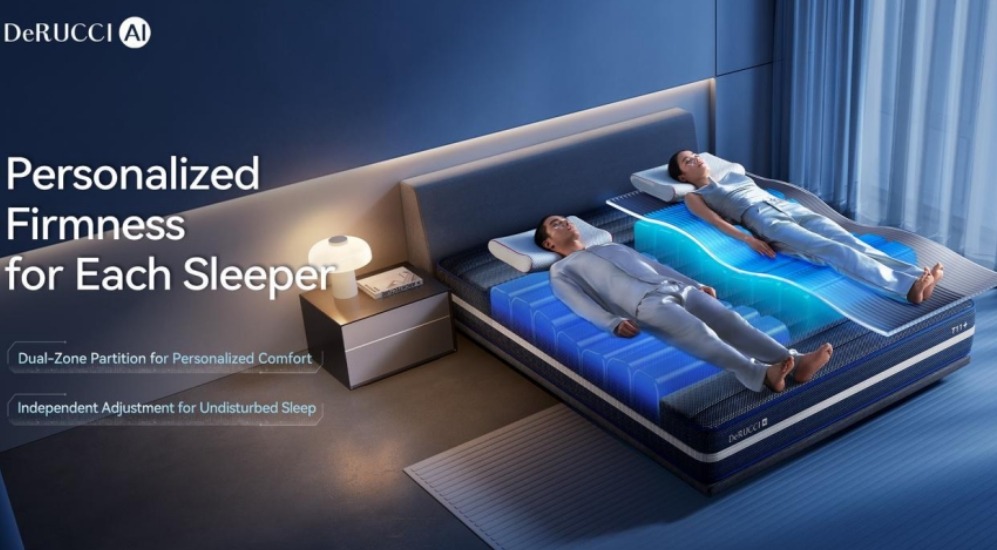
Dual-Drive independent adjustment is especially relevant for couples. One partner may change position more often, prefer a softer or firmer feel, or need support in a different body zone. With each side adjusting independently, movement on one side is less likely to disturb the other side. In everyday use, tossing and turning becomes less of a shared problem and more of something the mattress can manage separately.
Independent testing also shows why measured outcomes need to be stated clearly. According to independent CAICT lab testing on DeRUCCI T11+, sleep onset time, meaning the time needed to fall asleep, was 37.3% shorter. If a person usually takes 30 minutes to fall asleep, that is about 11 minutes saved. Nighttime turnovers were reduced by 27.5%, meaning the sleeper tossed and turned almost 30% less, which can also give a partner a quieter night. Deep, restorative sleep duration increased by 4.5%, and continuous deep sleep increased by 5.9%, meaning rest became less fragmented and more restorative in the tested conditions.
Availability should also be clear before readers compare models. The T11 series AI smart mattress is currently available in Australia, Singapore, Malaysia, and Vietnam, while it is not currently sold in the United States or Canada. Readers in available markets can review AI smart mattress availability in Australia, Singapore, Malaysia, and Vietnam to explore T11 series options.
FAQ answers should help readers separate practical sleep monitoring from broad marketing claims. The key point is straightforward: an AI smart mattress should track nightly signals, explain patterns clearly, and support comfort while staying within responsible wellness boundaries.
Frequently Asked Questions
Can an AI smart mattress monitor sleep health without wearables?
Yes. A well-designed AI smart mattress can monitor sleep health without a watch, ring, or chest strap. DeRUCCI T11 PRO uses built-in sensors and the SleepCare System to read signals through the mattress surface. This allows the bed to follow heart rhythm, breathing patterns, movement, and sleep phases while the user rests normally.
What is the difference between a sleep tracker and an AI smart mattress?
A sleep tracker mainly records and reports. An AI smart mattress can record, analyze, and respond. The difference is the closed loop: monitoring captures signals, analysis identifies sleep patterns, and active support adjusts comfort through systems such as AutoFit 6-Zone support and Dual-Drive independent adjustment.
Can an AI mattress diagnose sleep disorders?
No. An AI smart mattress can show patterns related to sleep quality, breathing rhythm, movement, and rest continuity, but it does not diagnose medical conditions. If the data suggests persistent concerns, the user should consult a qualified healthcare professional. The mattress is a wellness and comfort product, not a medical diagnostic device.
Where is the T11 series currently available?
The DeRUCCI T11 series AI smart mattress is currently available in Australia, Singapore, Malaysia, and Vietnam. It is not currently sold in the United States or Canada. North American readers can still explore DeRUCCI’s available traditional mattresses, bed frames, and home comfort products through official channels.
Explore DeRUCCI In Store
For readers who want to compare comfort in person, showroom guidance is often more useful than reading specifications alone. Visit a local DeRUCCI store to experience support feel, product fit, and available models for the relevant market. Discover more in store: global store locator and showroom details.