
Run a few paragraphs of AI-generated text through a humanizing tool, and something strange sometimes happens: the AI detector score drops, but so does the writing. A sentence that was clean and grammatically sound comes out slightly off. A comma sits somewhere it shouldn’t. A phrase reads like it was translated twice.
That raises an uncomfortable question. If the goal of an AI humanizer is to make writing sound more human, why would a tool ever make the grammar worse?
The short answer is that “less predictable” and “more human” are not the same thing and in certain outputs, tools chase the first at the expense of the second. This isn’t true of every humanizer, or every output. But it happens often enough that it’s worth understanding what’s actually going on under the hood, and how to tell the difference between a tool that’s genuinely improving your writing and one that’s just scrambling it.
Why AI-Generated Writing Can Sound Predictable
Before getting into what humanizers do, it helps to understand the problem they’re trying to solve.
Large language models tend to write in patterns. Sentences cluster around a similar length. Transitions repeat “moreover,” “in conclusion,” “it’s important to note.” Paragraphs open the same way, build the same way, and land on the same tidy summary. None of it is wrong, exactly. It’s just uniform in a way human writing usually isn’t.
That uniformity is measurable. Researchers describe it in terms of low entropy and low burstiness — technical ways of saying the text is too smooth and too evenly paced. Human writing, by contrast, tends to be “bursty”: some sentences run long and clause-heavy, others are short and blunt, and the rhythm shifts depending on what the writer is trying to emphasize. AI detectors, at a basic level, are looking for the absence of that variation.
None of that requires bad grammar. It just requires variation — in sentence length, structure, word choice, and rhythm. That distinction matters, because it’s exactly where some humanizers start cutting corners.
Why Some AI Humanizers Change Grammar and Sentence Structure
To break up predictable patterns, an AI humanizer typically does some combination of the following:
- Sentence restructuring: Splitting long sentences, merging short ones, or reordering clauses
- Vocabulary variation: Swapping repeated words for synonyms
- Rhythm adjustment: Deliberately mixing short and long sentences
- Tone shifting: Nudging phrasing toward a more conversational register
Done carefully, this is just editing. It’s what a human editor does to a first draft. The problem shows up when a tool treats “unpredictable” as the entire goal, rather than a byproduct of good writing. If a system is optimizing primarily to lower a detector’s confidence score, the fastest way to do that is often to introduce irregularity and grammatical mistakes are a very cheap, very effective way to create irregularity. A dropped article, a subject-verb mismatch, an oddly placed modifier: these all reduce the statistical smoothness that detectors key on. They also, not coincidentally, make the writing worse.
Depending on the tool and its settings, this trade-off can be minor and barely noticeable, or it can be significant enough that the output needs a full editing pass before it’s usable. The result may vary widely even between two runs of the same tool.
Does Bad Grammar Actually Make Writing Look More Human?
Short answer: Not really. Humans make mistakes, but human writing isn’t defined by mistakes it’s defined by voice, judgment, and natural variation. Random grammatical errors can actually make text look more artificial, not less, because real human mistakes tend to follow patterns (a misplaced modifier under time pressure, a dropped word while typing fast), while machine-inserted “errors” often look arbitrary.
Here’s the distinction worth holding onto:
- Natural variation: The kind a skilled human editor introduces improves clarity while breaking up predictable rhythm.
- Artificial mistakes: The kind some detection-focused tools introduce reduce predictability but also reduce readability, credibility, and trust.
A reader (or an editor, or a hiring manager, or a professor) doesn’t experience “lower AI-detection probability.” They experience a sentence that either makes sense or doesn’t. Poor readability isn’t proof of human authorship. It’s just poor readability, and it tends to undermine the exact goal sounding credible and human that the tool was supposed to serve.
The Trade-Off Between AI Detection and Writing Quality
This is the core tension, and it’s backed by more than intuition.
A 2024 study published in Transactions on Machine Learning Research tested several methods for making AI-generated text evade detectors, then had human evaluators rate the readability of the output against real human-written text on a 1–5 scale. The results varied a lot by method. One widely-cited paraphrasing approach produced text that scored noticeably lower on readability than the human baseline, the single largest quality drop among the methods tested. Other, more carefully engineered approaches came within a fraction of a point of human-written text while still evading detectors effectively.
The takeaway isn’t “detection evasion always hurts quality.” It’s that the two goals are only loosely correlated, and cheaper methods tend to sacrifice quality faster than more sophisticated ones. A tool that’s optimized purely for a lower detector score, with no separate check on grammar or readability, will tend to land in that first category.
This is why judging an AI humanizer by a single detector score is incomplete. A useful evaluation has to weigh several things at once:
| Factor | What it tells you |
|---|---|
| Detector score | How likely current detectors are to flag the text |
| Grammar | Whether sentences are structurally correct |
| Clarity | Whether the meaning is easy to follow on first read |
| Meaning preservation | Whether the rewrite still says what the original said |
| Tone | Whether the voice fits the intended audience |
| Editing effort | How much manual cleanup the output needs before it’s usable |
The best output isn’t simply the one that scores lowest on a detector. It’s the one that reads naturally while staying clear, accurate, and usable without heavy editing.
We Tested Three AI Humanizers
To see how this plays out in practice, we ran the same source passage through three tools built for this purpose: AIHumanizer.io, HumanizeText.io, and SuperHumanizer.ai.
Methodology: We used a single AI-generated source paragraph as input across all three tools, with the settings noted for each. Each output was reviewed for grammar, readability, meaning preservation, and the amount of manual editing it would realistically need before publication — summarized in the table below. We did not select outputs based on which detector score looked best; a low detector score with heavy grammar damage was scored as a weaker result, not a stronger one.
What Each Tool Is Built For
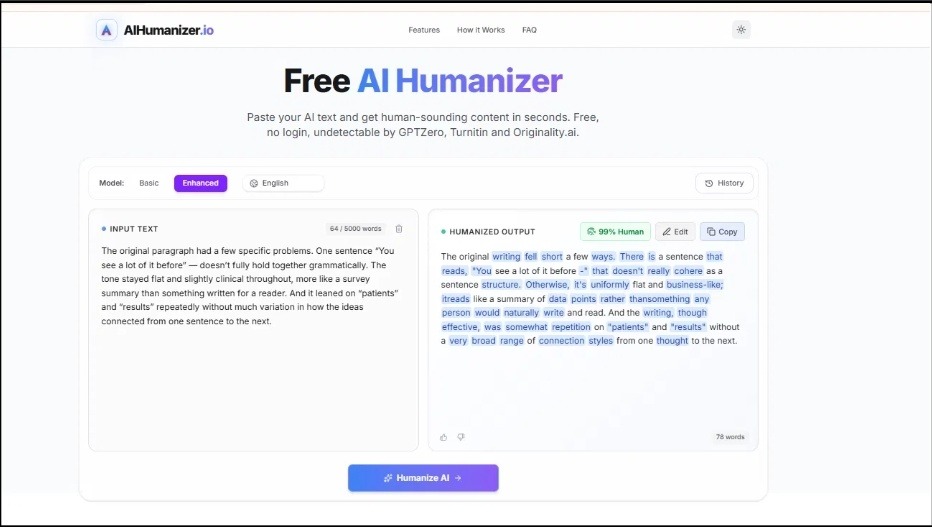
AIHumanizer runs two processing modes, Basic and Enhanced, with support for a wide range of languages. Beyond rewriting, it includes a sentence-level regeneration feature — click any individual sentence to swap in an alternate phrasing rather than re-running the whole passage. Its stated focus is evading specific detectors (GPTZero, Turnitin, Originality.ai, Copyleaks), with grammar and phrasing cleanup positioned as a secondary benefit of that process.
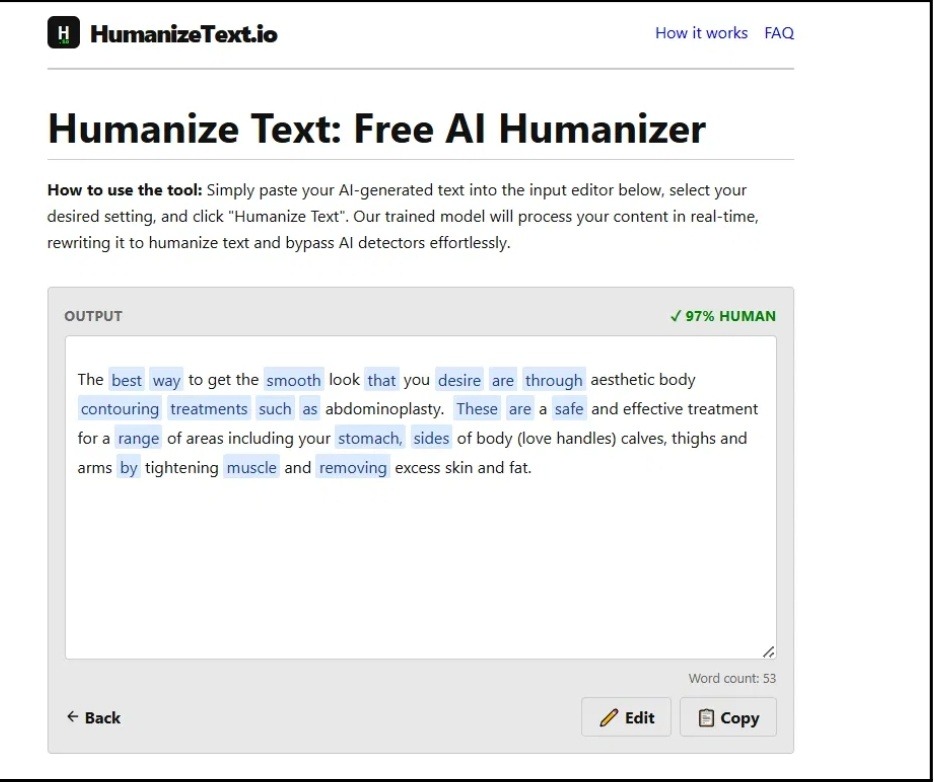
HumanizeText.io separates its modes by use case: “Basic (General)” for everyday content and “Enhanced (Academic/Pro)” for higher-stakes writing like essays and assignments. Two features stand out — a word-difference highlighter that shows exactly what was changed, and a sentence-alternative generator for targeted spot edits without reprocessing the full text. It also preserves formatting (headings, paragraph breaks) when content is pasted into a doc, and it’s positioned toward students, SEO writers, and business professionals specifically.
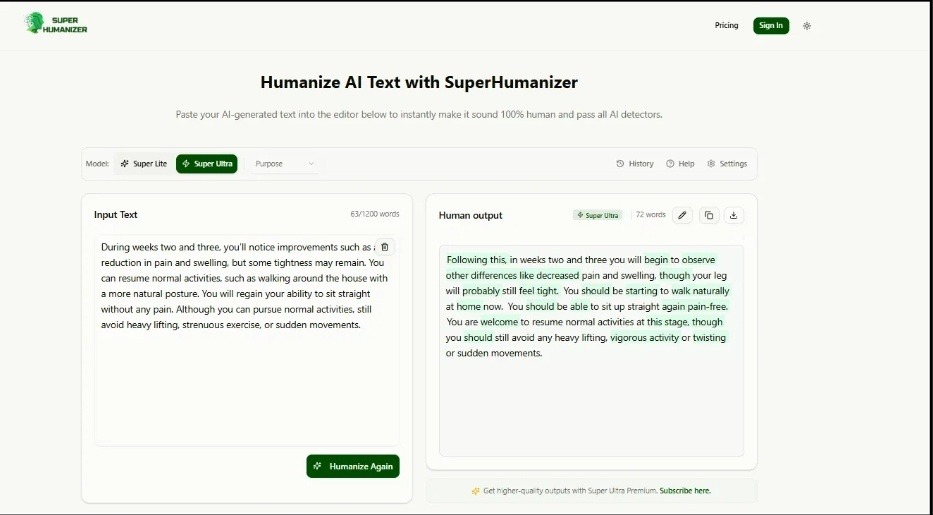
SuperHumanizer.ai offers “Super Lite,” a single-pass rewrite, and “Super Ultra,” which the tool describes as validating its own output against internal quality checks before returning it. It ships a built-in AI-detection checker so users can test the score without leaving the page, and the site cites training on a filtered set of roughly one million human-written samples.
A quick transparency note: all three tools’ own marketing pages use language this piece deliberately avoids “100% undetectable,” “guaranteed to bypass all popular AI detectors,” and in SuperHumanizer’s case, a specific “97% success rate” claim. None of those figures are independently verified here; the descriptions above stick to what was directly observed rather than repeating the tools’ own guarantee language.
Source passage (64 words)
The original paragraph had a few specific problems. One sentence “You see a lot of it before” doesn’t fully hold together grammatically. The tone stayed flat and slightly clinical throughout, more like a survey summary than something written for a reader. And it leaned on “patients” and “results” repeatedly without much variation in how the ideas connected from one sentence to the next.
AIHumanizer.io output (Enhanced mode, self-reported 99% Human, 78 words):
The original writing fell short in a few ways. There is a sentence that reads, “You see a lot of it before -” that really doesn’t cohere as a sentence structure. Otherwise, it’s uniformly flat and business-like; it reads like a summary of data points rather than something any person would naturally write and read. And the writing, though effective, was somewhat repetitive on “patients” and “results” without a very broad range of connection styles from one thought to the next.
HumanizeText.io output (self-reported 94% Human, 57 words):
There were several issues with the paragraph in its original form. Its not very readable. You see a lot of it before just doesn’t hold together from a grammatical standpoint. It remained rather clinical all through, and you couldn’t discern a reader trying to connect ideas with it. Patient after patient, and result after result, were repeated.
SuperHumanizer.ai output (Super Lite mode, 58 words):
The original was a bit dodgy. One line (“You see a lot of it before”) didn’t quite work grammatically. The tone remains fairly flat and a bit overclinical, more like an overview from the survey than something written for a reader. The writer relied excessively on “patients” and “results” without much change in the flow of thoughts.
| Tool | Self-Reported Score | Grammar Errors Found | Readability | Meaning Preserved | Editing Effort |
|---|---|---|---|---|---|
| AIHumanizer.io | 99% Human | 4 missing preposition, run-on clause, 2 fused-word typos (“itreads,” “thansomething, 1 misused noun | Interrupted by the fused-word sentence, which requires re-reading | Largely intact, but obscured by the errors around it | High — at least 2 of 4 sentences need a rewrite |
| HumanizeText.io | 94% Human | 3 consistent missing-apostrophe pattern (Its, doesnt, couldnt), plus one meaning-drifting clause | Mostly smooth; the apostrophe errors and one confusing clause interrupt flow | Slight drift in one sentence’s framing | Moderate — largely punctuation fixes, one clarity edit |
| SuperHumanizer.ai | Not shown on this run | 0 — no dropped punctuation, spacing, or agreement errors found | Best of the three; reads smoothly on first pass | Closest to the original’s intent | Low — one optional stylistic tweak |
What Users Should Look For in an AI Humanizer
Detector-score marketing is easy to find. What’s harder to find — and more useful — is a tool that’s transparent about the trade-off described above. A few things worth checking before relying on any AI humanizer:
- Natural sentence variation, not just randomized structure
- Preserved meaning — the rewrite should say what you meant, not something adjacent to it
- Readable output on the first pass, without requiring a full rewrite
- Grammar control — ideally a setting or mode that prioritizes correctness alongside naturalness
- Tone flexibility for different contexts (academic, marketing, casual)
- Transparency about how the tool works, rather than vague guarantees about beating every detector
The checklist above is really a proxy for one question: does the output need less editing than starting from scratch would? A tool whose answer is “trust the score” is worth treating as a yellow flag, not a green one.
Conclusion
Writing mistakes are human. But mistakes alone don’t make writing human voice, judgment, and natural variation do. An AI humanizer that leans on artificial errors to dodge detection is optimizing for the wrong signal, and the cost shows up later, when a real reader hits a sentence that doesn’t quite work.
A genuinely useful humanizer should do what a good editor does: vary the rhythm, cut the repetition, and let the writing breathe without breaking what made it readable in the first place. That’s a harder problem to solve than simply lowering a score. It’s also the only version of this technology actually worth using.
FAQ
Why do AI humanizers make grammar mistakes?
Some tools reduce a detector’s confidence score by introducing irregularity into the text. Grammatical errors are one of the cheapest ways to create that irregularity, so tools optimized narrowly for detection scores can end up trading grammar for a lower score.
Do AI humanizers intentionally add writing mistakes?
Not always, and not by explicit design in every case — but depending on the tool and how it’s optimized, the practical effect can be similar: sentence structures get altered in ways that reduce accuracy rather than improve natural variation.
Can poor grammar make AI-generated text look more human?
Not reliably. Human writing isn’t defined by errors — it’s defined by natural rhythm and voice. Random mistakes often look more artificial than natural, because they don’t follow the patterns real human errors tend to follow.
Does an AI humanizer guarantee that text will avoid AI detection?
No tool can honestly guarantee that, since detectors are updated regularly and results vary by detector, text length, and topic. Treat any absolute guarantee with skepticism.
Why does AI-generated text often sound unnatural?
It tends to follow predictable patterns — uniform sentence length, repeated transitions, and low variation in rhythm — which is measurably different from how most human writing behaves.
Can AI humanizers improve writing without damaging grammar?
Yes. The tools and methods that perform best combine natural sentence variation with attention to grammar and meaning preservation, rather than optimizing for a detector score alone.
What should you look for in an AI humanizer?
Natural variation, preserved meaning, readable output, grammar control, and transparency about how the tool works — not just a low detector score.
Is natural-sounding writing the same as grammatically incorrect writing?
No. Natural writing has rhythm and variation but is still structurally correct. Grammatically incorrect writing is a separate problem that can make text look worse, not more human.