Introduction
Printed Circuit Boards (PCBs) are the foundation of modern electronics. From smartphones and laptops to medical equipment, industrial automation systems, automotive electronics, and telecommunications devices, nearly every electronic product depends on a reliable PCB. While innovative circuit design plays an important role, the manufacturing quality and material selection ultimately determine how well a circuit board performs over time.
Poor-quality circuit boards can lead to electrical failures, overheating, signal interference, and reduced product lifespan. In contrast, professionally manufactured PCBs provide greater reliability, improved efficiency, and long-term performance. Understanding both the manufacturing process and the materials used allows businesses to develop electronic products that meet today’s demanding quality standards.
Understanding the PCB Manufacturing Process
A well-controlled PCB Manufacturing Process is essential for producing reliable and high-performance circuit boards. Every stage, from design verification to final inspection, contributes to the board’s overall quality and functionality.
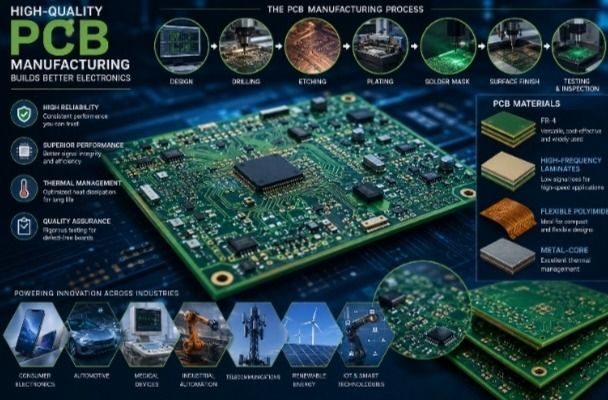
The process typically begins with PCB layout design, followed by substrate preparation, copper pattern imaging, etching, drilling, plating, solder mask application, surface finishing, electrical testing, and final quality inspection. Each stage must be completed with precision to ensure accurate dimensions, strong electrical connections, and consistent product quality.
Modern manufacturing facilities use automated equipment and strict quality control systems to reduce defects and maintain tight production tolerances. This level of precision is especially important for industries where product reliability is critical.
Why PCB Materials Matter
Selecting the right PCB Materials is equally important because material properties directly affect electrical performance, mechanical strength, thermal stability, and durability. Different electronic applications require different material characteristics depending on operating conditions and performance expectations.
The most widely used material is FR-4, which combines fiberglass and epoxy resin to provide excellent electrical insulation, flame resistance, and mechanical stability. For applications involving high frequencies, specialized laminates help reduce signal loss and improve communication performance. Flexible polyimide materials are commonly used in wearable electronics and compact devices, while metal-core boards provide superior heat dissipation for LED lighting and power electronics.
Choosing suitable materials ensures that circuit boards perform reliably under varying temperatures, humidity levels, and mechanical stress.
Benefits of High-Quality PCB Manufacturing
Manufacturing quality directly influences the overall performance of an electronic product. Even the most advanced circuit design cannot perform efficiently if manufacturing defects are present.
Professionally manufactured PCBs offer numerous advantages, including improved electrical conductivity, more precise trace dimensions, stronger solder joints, better heat management, and greater resistance to environmental factors. These benefits contribute to longer product life, fewer failures, and lower maintenance costs.
High manufacturing standards also reduce the likelihood of short circuits, open circuits, and component misalignment, helping manufacturers deliver dependable electronic products to customers.
Common PCB Materials Used Across Industries
Different industries require circuit boards with different performance characteristics. Manufacturers select materials according to the product’s operating environment and functional requirements.
FR-4 remains the industry standard for consumer electronics because it provides an excellent balance of cost and performance. High-frequency laminates are preferred for telecommunications equipment, radar systems, and RF devices where signal integrity is essential.
Metal-core boards are widely used in automotive lighting, industrial power supplies, and LED products because they efficiently dissipate heat. Flexible PCBs support compact designs in smartphones, cameras, wearable technology, and medical devices, while ceramic materials provide exceptional thermal performance for aerospace and high-power applications.
Selecting the correct material helps manufacturers improve both reliability and product efficiency.
Industries That Depend on Precision PCB Manufacturing
Printed circuit boards play a vital role across numerous industries where reliability and performance cannot be compromised.
Consumer electronics manufacturers depend on precision PCBs for smartphones, tablets, laptops, gaming devices, and smart home products. Automotive companies use advanced circuit boards in electric vehicles, safety systems, infotainment units, and engine control modules.
Medical equipment manufacturers require highly reliable PCBs for patient monitoring systems, diagnostic devices, imaging equipment, and surgical instruments. Industrial automation relies on durable circuit boards for robotics, programmable controllers, sensors, and manufacturing machinery.
Telecommunications, aerospace, defense, renewable energy, and IoT technologies also require professionally manufactured PCBs that can operate in demanding environments.
Factors to Consider Before Choosing a PCB Manufacturer
Choosing the right PCB manufacturer is just as important as selecting the right design. A reliable manufacturer should maintain strict quality control standards and offer advanced manufacturing capabilities.
Businesses should evaluate manufacturing experience, production capacity, inspection procedures, certifications, lead times, material options, and technical support before selecting a supplier. Reviewing previous projects and customer feedback can also provide valuable insight into a manufacturer’s expertise.
Working with an experienced manufacturing partner helps reduce production risks while ensuring consistent product quality throughout every stage of development.
Future Trends in PCB Technology
The electronics industry continues to evolve rapidly, creating demand for more advanced PCB technologies. Manufacturers are developing thinner boards, higher-density interconnects, improved thermal materials, and environmentally friendly manufacturing processes.
Emerging technologies such as artificial intelligence, electric vehicles, 5G communication, wearable electronics, and smart manufacturing require increasingly sophisticated circuit boards capable of handling higher processing speeds and greater power efficiency.
As innovation continues, manufacturers will focus on improving reliability while reducing production costs and environmental impact.
Conclusion
Printed circuit boards remain one of the most important components in modern electronic products. A precise manufacturing process combined with carefully selected materials ensures superior electrical performance, long-term reliability, and greater product durability.
Whether developing consumer electronics, medical devices, industrial equipment, automotive systems, or advanced communication technologies, investing in professional PCB manufacturing delivers significant long-term benefits. By understanding the importance of manufacturing quality and material selection, businesses can produce dependable electronic products that perform consistently in today’s competitive marketplace.
FAQs
- What is the PCB manufacturing process?
The PCB manufacturing process includes design verification, copper pattern creation, drilling, plating, solder mask application, surface finishing, testing, and quality inspection to produce reliable circuit boards. - Why are PCB materials important?
PCB materials determine the board’s electrical performance, heat resistance, mechanical strength, durability, and overall reliability in different operating environments. - Which PCB material is most commonly used?
FR-4 is the most widely used PCB material because it offers excellent electrical insulation, flame resistance, durability, and cost-effectiveness. - Which industries rely on high-quality PCBs?
Consumer electronics, automotive, medical devices, aerospace, industrial automation, telecommunications, renewable energy, and IoT industries all depend on high-quality printed circuit boards. - How can businesses choose the right PCB manufacturer?
Businesses should evaluate a manufacturer’s experience, certifications, quality control procedures, production capabilities, material options, lead times, and customer support before making a decision.