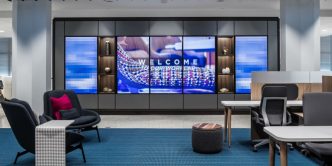
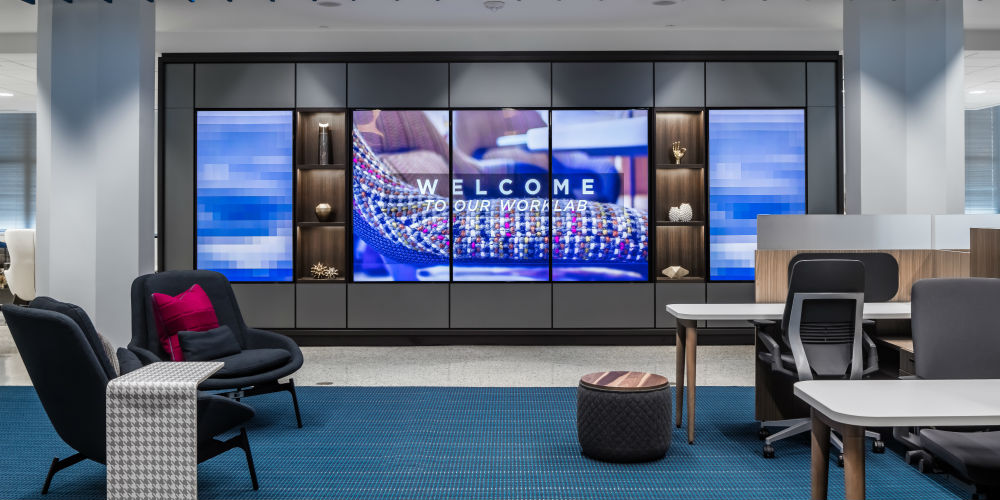
If you’ve walked into a modern corporate lobby lately, you’ve probably noticed something: the old framed art and static logo signs are slowly disappearing. In their place? Video walls. Big, bright, attention-grabbing displays that don’t just decorate a space, they tell visitors exactly who you are within seconds of walking through the door.
That’s exactly what a growing technology company in Allen, Texas, was after when they reached out to CMG Visuals. They were wrapping up a major lobby renovation and wanted a centerpiece that felt as forward-thinking as the company itself. What followed was a project that’s worth breaking down, because honestly, there’s a lot you can learn from it whether you’re planning your own install or just curious about how these things actually come together.
Starting With the Space, Not the Screen
Here’s the thing most people get wrong about video walls: they start by shopping for displays. They scroll through specs, compare brands, and get fixated on resolution numbers before anyone’s even measured the room.
The CMG Visuals team did the opposite. Before recommending a single product, they showed up on-site in Allen and spent time actually studying the lobby. And there were real challenges to deal with. The lobby had floor-to-ceiling windows pouring in Texas sunlight all day, which meant a standard display would have looked washed out by 10 a.m. The main entrance sat about twelve feet from the focal wall, so viewing distance had to factor into the pixel pitch decision. And the client wanted to run both polished brand videos and live data dashboards during business hours, two very different content types with very different visual demands.
Quick tip: If you’re planning a video wall, your first conversation with an integrator should be about your space, your lighting, your viewing angles, and your content goals. If somebody’s leading with product brochures instead of questions, that’s a red flag.
Picking the Right Technology for the Job
After the walkthrough, CMG Visuals recommended a fine-pitch LED video wall with a 1.5mm pixel pitch and a brightness level specifically rated to handle daylight-heavy interiors. They chose LED over a tiled LCD setup for a simple reason: bezels. With LCD panels, you get thin black lines where the screens meet, and at twelve feet of viewing distance, those lines would have been noticeable and distracting. LED gives you one continuous, seamless image — which is what you want when the wall is going to be the first thing every visitor sees.
A helpful rule of thumb here: the minimum comfortable viewing distance in feet is roughly the pixel pitch (in millimeters) multiplied by three. So a 1.5mm pitch is comfortable from about 4.5 feet and beyond. Go too fine and you’re paying for resolution nobody can perceive. Go too coarse and the image looks pixelated up close. CMG Visuals matched the pitch to the actual room, not to a spec sheet.
The Stuff Nobody Talks About: Structural Prep
Here’s something a lot of clients don’t realize until they’re knee-deep in a project: video walls aren’t just hung on the wall like a flat-screen TV. The Allen install required custom wall reinforcement to support the weight of the LED cabinets, dedicated power circuits, concealed cable runs, and a ventilation strategy so the wall wouldn’t overheat behind the panels.
CMG Visuals coordinated directly with the client’s general contractor through this phase, which saved everyone a lot of headaches. Electrical, structural, HVAC, and integration teams were all on the same page before a single panel got mounted. If you’re planning a renovation and you know a video wall is in your future, loop in your integrator during the design phase. Retrofitting later costs significantly more than getting it right the first time.
Making It Easy to Use After Install Day
A video wall that nobody on the marketing team can update is a video wall that ends up showing the same content for six months. CMG Visuals set up a content management system that lets the client’s in-house team schedule playlists, swap content, and push live dashboard feeds without needing to call anybody for support. They walked the staff through the platform, left documentation, and made sure the people who’d actually be using the system day-to-day felt confident running it.
They also put a service agreement in place — scheduled maintenance, firmware updates, and on-call support if something ever goes sideways. Because here’s the reality: a video wall is a multi-year investment, and the install is honestly the easy part. Keeping it running beautifully five years down the road is where a good integrator earns their keep.
What Allen Businesses Can Take From This
The lobby in Allen now does exactly what the client wanted: it greets visitors with sharp, vibrant content that makes the company feel modern, capable, and confident. But more importantly, it works reliably, looks great in every lighting condition, and gives the marketing team a tool they can actually use.
If you’re an Allen-area business thinking about a video wall — whether for a lobby, a conference room, a retail space, or a control center — the takeaway is this: the technology is only one piece of the puzzle. The environment, the structural prep, the content workflow, and the ongoing service matter just as much. Working with an integrator like CMG Visuals, who handles all of it under one roof, means you’ve got a single point of accountability instead of juggling three or four vendors who all blame each other when something goes wrong.
That single-source approach is what made the Allen project run smoothly from kickoff to handoff. And honestly, that’s the standard more businesses should be holding their AV partners to. A great video wall isn’t just about pixels; it’s about the people behind it making sure those pixels keep doing their job for years to come.
Conclusion
A video wall isn’t just an AV upgrade; it’s a long-term investment in how your business shows up the moment someone walks through the door. The Allen project proves that the real difference doesn’t come from the panels themselves. It comes from the planning, the coordination, and the ongoing support that surrounds the install. That’s the value CMG Visuals brings, one team handling everything from kickoff to year-five maintenance. So if you’re thinking about a video wall, don’t shop for screens. Shop for a partner who’ll still be in your corner long after install day.
Frequently Asked Questions
1. How much does a custom video wall installation typically cost?
It depends on the size, pixel pitch, brightness rating, structural prep, and service agreement. Most corporate lobby installs land in the five- to six-figure range. CMG Visuals offers on-site assessments to scope your project before quoting a number.
2. How long does a video wall installation take?
Most corporate projects run four to twelve weeks from contract to handoff. The on-site install itself is usually two to five days, but planning, structural prep, and equipment lead times make up the bulk of the timeline.
3. What’s the difference between LED and LCD video walls?
LED gives you one seamless image with no bezel lines, making it ideal for lobbies and high-visibility spaces. LCD tiled walls are usually less expensive but have visible seams between panels. For close viewing distances, LED is almost always the better call.
4. Do you offer ongoing service after the install?
Yes. CMG Visuals provides service agreements covering scheduled maintenance, firmware updates, on-call support, and component replacement, because a video wall is a multi-year asset, and keeping it running beautifully matters as much as the install itself.