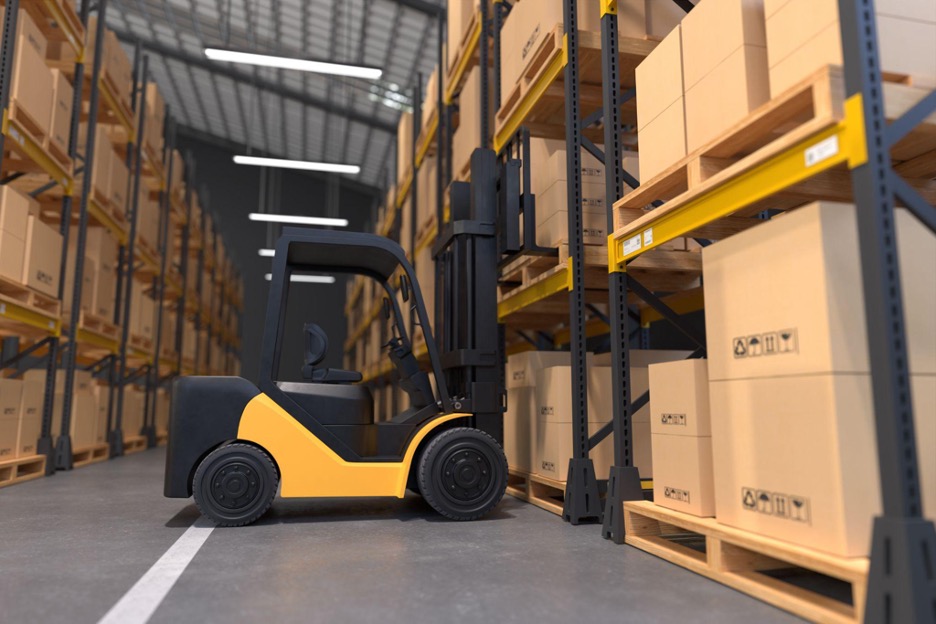
There was once a time when warehouses had to rely on manual work, and manual work only.
You had workers walking long aisles with clipboards, searching for items, double-checking stock, and moving goods by hand or with basic tools. Delays happened daily, mistakes slipped through, and scaling operations meant hiring more people rather than improving the process.
Well, those days are over. Now, you’re working in a completely different environment where speed, accuracy, and real-time visibility all affect how warehouses work.
With modern warehouse equipment, you get more data and fewer repetitive tasks.
Keep reading to learn how specific types of equipment are changing logistics for the better.
Automated Storage and Retrieval Systems (AS/RS)
Do you think you need more floor space? Think again — you need to use more of the space you already have. That’s what automated storage and retrieval systems are for.
AS/RS handles the placement and retrieval of goods without constant human input.
Instead of workers searching for items, the system brings the items to them. This reduces not only travel time, but also picking errors that often come with manual handling.
You also get vertical storage. High-density racking combined with automation lets you store more in the same footprint.
The real impact? Orders keep moving, even during busy periods. You don’t see delays from tired workers or crossed wires between teams.
Successful warehouses know this. In fact, Gartner predicts that over 75% of companies will adopt some form of cyber-physical automated warehouse processes by 2027.
Picking and Packing Automation Tools
You already know that order fulfillment is where small delays show up most. Manual picking and packing often lead to missed items, wrong quantities, or slow processing times.
Modern warehouse equipment is there to help with automation.
Systems like pick-to-light and voice picking guide workers step by step, so there’s no guesswork. Every action gets confirmed instantly, so no error ever reaches the customer.
Packing becomes faster, too. Machines do all the work of measuring, packing, and labeling, and they do it the same way every time. They don’t get tired or confused.
In simple words:
- Orders move through your warehouse faster, without constant stops
- You deal with fewer returns because picks are correct the first time
- Your team spends less time fixing errors and more time getting orders out the door
It’s what directly impacts customer satisfaction and repeat business.
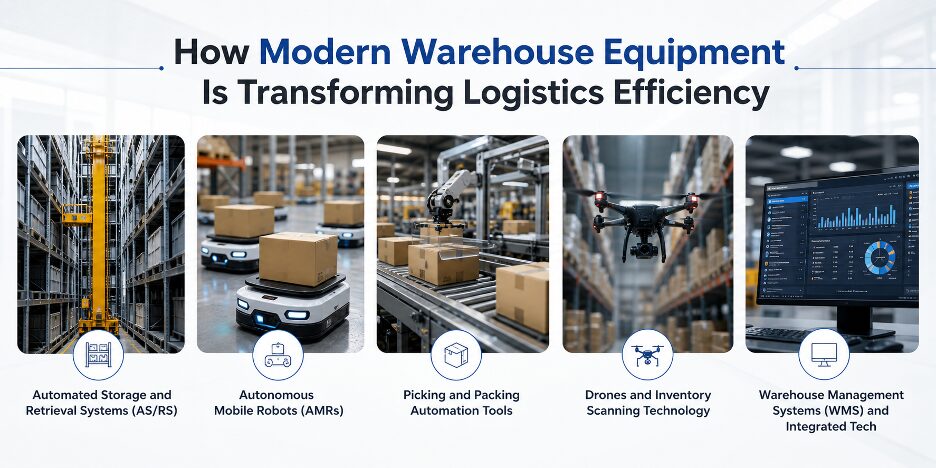
Drones and Inventory Scanning Technology
Stock checks used to take hours. Sometimes even days. Workers had to pause operations, climb racks, and count items one by one. Such a process isn’t just impractical, but also leads to errors and wasted time.
With drones, you can handle this differently. They go through aisles, scan barcodes, and update records without stopping the usual work. This works especially well in large warehouses or areas that are hard to reach.
Think about cycle counting without having to shut down entire sections. Or easily scanning high storage locations that are difficult to access.
Warehouse Management Systems (WMS) and Integrated Tech
Equipment alone won’t fix inefficiencies if systems don’t sync. A central layer, on the other hand, can connect everything.
A warehouse management system does exactly that. It tracks stock, assigns tasks, and keeps every part of the operation aligned in real time. You always know what’s in stock, where it is, and what needs to move next.
Is your goal strong inventory control? Do you want fewer manual counts and assumptions?
Well, this technology will get you accurate data that updates as work happens. That reduces stock discrepancies and helps you avoid overstocking or shortages.
But the most powerful part is integration. The WMS works with robots, conveyors, and scanning tools to create one coordinated flow. Then, tasks don’t get assigned randomly but based on priority and availability.
Looking at the bigger picture, you won’t achieve this efficiency with a single piece of equipment. You need everything working together, in one ecosystem of tools, machines, and data.