Digitalization is evolving at another level and networking devices are playing a very important role in how the businesses operate and communicate. The demand for dependable and high-performance infrastructure are continuing to grow as the organization expand their operations in 2026.
Businesses buy networking devices in bulk through wholesale channels to achieve significant price savings. Also, it ensures constant performance across every department. That is why, choosing the right networking setup is essential for your business efficiency, across a range of workloads.
This guide walks you through the top networking devices to help you choose devices that align with business expansion, performance requirements, and enterprise scalability goals.
Purchase Networking Devices in Bulk Quantities
If you are looking to scale efficiently then buy the networking devices in bulk to minimize the costs and maintain the consistency of the infrastructure. When you buy in bulk through wholesale suppliers, it provides you better pricing with simple deployment, and standardized performance across enterprise environments.
Price Efficiency and Budget Optimization
Buying networking devices in bulk have multiple benefits and one of them is the lower cost perunit. It allows the businesses to allocate the budget for other crucial IT investments while maintaining the high-quality networking infrastructure.
Simplified Deployment and Management
Standardized devices help make installation and configuration easier. This results in reducing setup time and making sure that performance is consistent throughout all locations and departments.
Scalability for Enterprise Expansion
Purchasing in bulk supplies prepares businesses for future expansion, making sure that additional devices are always available to support expanding network demands without any delays or lags.
Bulk network device purchasing is a strategic decision that helps enterprises or businesses in reducing costs, easing management, and ensuring readiness for future business expansion.
Wholesale Pricing and Enterprise Savings
The wholesale pricing is an important factor for businesses that are buying networking devices in bulk. They can enjoy supplier discounts, volume deals, and warranty options. This makes it easier for the business to attain the best value and maintaining the super quality dependable network hardware.
Understanding what LAN WAN Devices Are
The Local Area Network (LAN) and Wide Area Network (WAN) are essential components of hardware that enable the communication within the local networks and across broader geographical areas respectively.
In the typical office setup, the LAN devices are perfect to handle internal connectivity. On the other hadn, WAN devices are best to manage communication as it expadns beyond the office network.
You can combine them both to form a unified system. It supports secure, rapid, and reliable data transmission across every level of business infrastructure.
When you understand the differences between LAN and WAN devices, you will be enable to build a balanced network that can provide both internal efficiency and an external connection.
The Key Functions of Essential Network Devices
- Enables communication between connected devices within a network
- Transfers data efficiently between systems and endpoints
- Manages and directs network traffic to avoid congestion
- Provides secure access through authentication and filtering
- Connects local networks to external networks or the internet
- Supports scalability by allowing network expansion
- Ensures reliable performance and stable connectivity across business operations
Top 10 Networking Devices List 2026
There is the list of the different types of networking devices in terms of LAN and WAN. when you explore how each device functions within a network, you will be able to choose the correct hardware devices for performance, and scalability. It also ensure the efficient data flow across your business enviroment.
LAN Devices (Local Area Network)
1. Switch
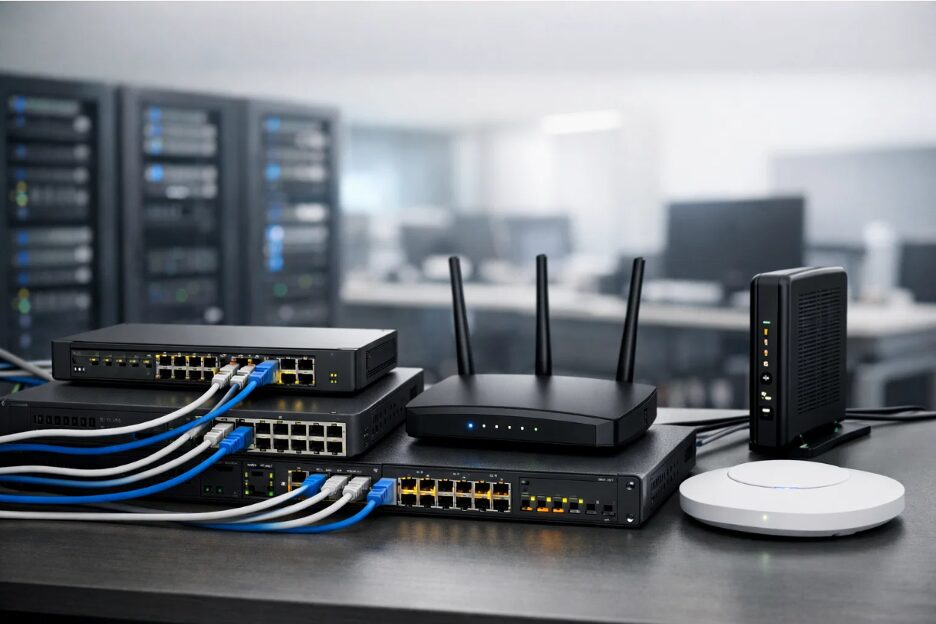
A switch connects multiple devices, such as computers, printers, and servers, within one network. A switch ensures effective data transfer by sending information directly to the intended device.
2. Wireless Access Point (AP)
A wireless access point allows Wi-Fi devices to connect to a wired network, helping to extend coverage and improve network connectivity across office spaces.
3. Network Interface Card (NIC)
A network interface card allows a computer or another device to connect to a network and acts as the physical interface for communication.
4. Hub
A hub is a basic device that connects a number of devices but broadcasts data to all ports, which makes it less effective in comparison with modern alternatives in hardware.
5. Bridge
A bridge is a device that connects different local areas between segments and filters traffic. In turn, the bridge reduces congestion and increases the efficiency of the network.
WAN Devices (Wide Area Network)
6. Router
A router is a device that connects multiple networks and directs data traffic in an efficient manner. This enables communication between internal networks and the internet.
7. Modem
A modem converts digital signals into analog form and analog form into digital signals, which allows data transmission over communication lines.
8. CSU/DSU (Channel Service Unit/Data Service Unit)
This type of device connects LANs to dedicated digital lines like T1 or E1, making sure of accurate transmission of signals.
9. Gateway
A gateway device connects different network setups and translates data between protocols, which allows communication between a variety of environments.
10. Core Switch
A core switch is a high-capacity device that is used in enterprise networks to help manage large volumes of data traffic in an effective manner.
The networking device plays a very specific role to supor the workload of a business and combining them in a correct manner results in high-perforamcne and stable infrastructure.
This is significant for the organizations and helps them to get the uninterrupted communication with effective data management with the ability to expand without any network bottlenecks and downtime.
Categorizing Network Infrastructure Hardware by Office Size
Selecting the best networking devices for office setup mostly depends on the size of your organization and its operational requirements.
You can match the selection of the hardware with the user demand, data load, and scalability aims. Especially, when it comes to bulk buying or through wholesale channels.
If you are a:
- Small business, then you need a simple configuration that includes a router, a switch, and a wireles access point to support the basic connection requirements.
- Medium sized business, you require more enhanced infrastructure which consists of managed switches, multiple access points, and strengthened security systems to handle increased traffic and users.
- Large enterprise, you need high-performance solutions such as core switches, enterprise-level routers, and dedicated security pieces to manage complex workload and data processing at a large scale.
Selecting networking devices on the basis of office size ensures optimal performance in an organization, along with cost efficiency, and the ability to scale as business requirements continue to expand and evolve.
Conclusion
Summarizing this, selecting the network devices for your organziation and making sure the right one is a difficult task for designing a reliable and future-ready infrastrucutre in 2026. As a business, you can invest in the correct combination of LAN and WAN to achieve improved perforamcen and better security.
For wholesale purchasers and enterprise environments, buying in bulk is helpful. You can save costs and establish consistency while scaling easier. A well-built business network supports present demands and prepares organzation for the future.