

Fintech is a nearly $400 billion global market, but closing a deal can still feel like navigating an obstacle course. The sales cycles in this highly regulated sector are notoriously bloated, often dragging on for 6 to 12 months.
Because risk management is built into their DNA, financial institutions rely on cross-functional buying committees to evaluate every move, including fintech investments. Furthermore, current regulations require buyers to conduct intensive compliance, security, and data governance audits of third-party vendors.
These hurdles make it difficult to know whether a buyer is in the market or just fishing for information. In fact, many fintech sales teams waste roughly 40% of their time chasing leads that look good on paper but have little or no buying intent.
This is where buyer intent data changes the game. It helps sales teams identify the buyers who have already cleared internal budget hurdles and are actively evaluating solutions. Better yet, it uncovers insights that drive stronger business outcomes beyond faster deal cycles.
The Signal vs. Noise Reality Check
Because the B2B buying journey is so convoluted, it’s difficult to know what a buyer is doing if your sales team relies on static data (company size, location, sector). For instance, according to Gartner’s now-famous B2B Buying Journey report, buyers spend only ~17% of their purchase decision time meeting with suppliers. The remaining 83% is independent digital research.
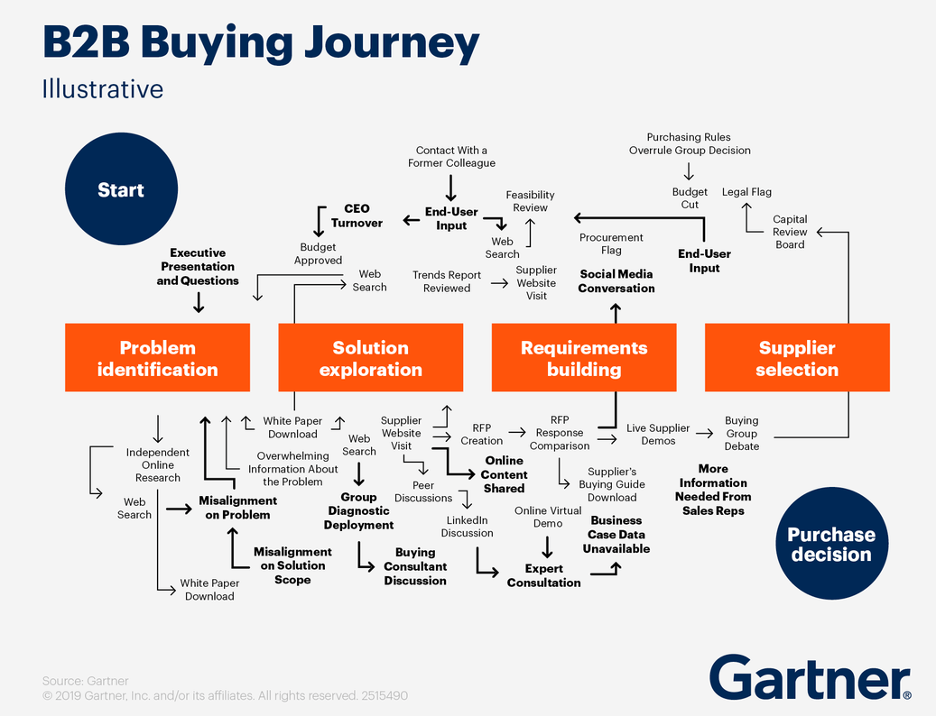
Ideally, you want your sales team to initiate contact at the transition point between the Solution Exploration and the Requirements Building phases. This is the sweet spot when the buying committee is actively deciding what features, compliance certifications, and integration capabilities are mandatory.
If your intent data flags a bank in this stage, your sales rep can step in as a consultant to help them draft those requirements. Without proper data-intent analysis, your sales reps have no idea how far along the journey a lead might be. Every step of the journey generates noise that looks promising.
This is how sales teams end up pitching core banking software to an institution that signed a 5-year contract with a competitor last month, simply because the institution meets the necessary requirements. Buyer intent data changes the question from “Who are they?” to “What are they doing right now?”
Tools for Your Team
In business analytics, everything starts with good data. But even the most accurate data can’t predict a lead’s buying journey with 100% certainty. It’s a game of predictive data analytics, behavioral psychology, and sales experience.
To reduce false positives and keep your team focused on leads that matter, you’ll need a three-tier tech stack:
- Prospecting tools, preferably powered by AI algorithms
- Predictive Account-Based Marketing and Revenue Intelligence platforms
- Tools that feed the data directly into your system
Prospecting tools act as the ears of the operation, listening to digital behaviors across the web to capture intent. They offer a wide range of options and features, so it’s worth running a few comparisons, such as the one on ZoomInfo.
Raw intent data is messy and difficult to untangle, which is why you’ll need Account-Based Marketing and Revenue Intelligence platforms to translate it into prioritized leads. Finally, to be useful to a fintech sales team, intent data must be fed directly into the tools they use every single day.
For instance, if an account surges on the topic “Strong Customer Authentication (SCA) compliance,” the CRM automatically pushes that account into a dedicated automated sequence. When the sales rep pens their dashboard, they have a pre-drafted, compliant email sequence ready to go, specifically tailored to SCA solutions.
Defensive Intent Data
The fintech world is evolving rapidly, and new, better solutions pop up every day. If your efforts die down after a lead becomes a paying customer, you might lose them to a competitor’s better offer.
Intent data can help here as well by flagging accounts that show signs they may want to leave (such as looking into migration guides or researching competitors). If caught early, these signs give your team the time to react and counteract the competitor’s offer.
By the time an enterprise client submits a formal non-renewal notice, it is usually too late to save the account.