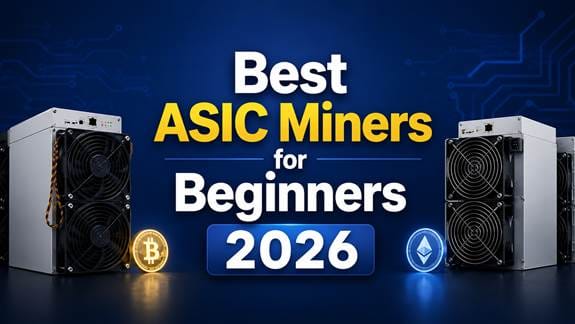
A weighted buyer’s framework – the five factors that actually decide your first miner, scored.
Most first-time buyers pick a miner the way they pick a phone – by the biggest number on the box. But terahashes don’t pay your power bill; joules per terahash do. The best beginner ASIC in 2026 is not the fastest or the cheapest – it’s the one whose efficiency, running cost, and payback line up with where you’ll actually plug it in. This guide replaces gut-feel shopping with a five-factor scoring framework, then runs today’s most popular machines through it so you can see, in numbers, which one fits you.
We are OneMiners, the world’s largest Bitcoin-mining and hosting company, and we sell and host over 700 miner models across a 2,163 MW, 20-site global network. We have watched thousands of beginners buy their first rig, and the pattern is consistent: the buyers who win optimize for efficiency and electricity rate first, hardware price second. Here’s how to do the same.
Key takeaways
- The factor beginners get most wrong: chasing hashrate (TH/s) instead of efficiency (J/TH) paired with your power rate.
- In 2026, efficiency is the dividing line – anything under ~17 J/TH stays profitable at a low hosted rate; older 30+ J/TH gear often bleeds cash.
- Best all-round beginner buy: Antminer S21 Pro (245 TH/s, 15.0 J/TH, ~$2,059 per the live OneMiners catalog).
- Best low-budget entry: Antminer T21 (~$996) or the S21 (Air) at ~$1,119.
- Where a miner runs matters more than the model: hosted at OneMiners from $0.0364/kWh beats a garage at $0.15/kWh – every time.
- Live hashprice sat near $30.88/PH/day in late July 2026 (Hashrate Index), so margins are thin – efficiency is non-negotiable.
The factor almost every beginner gets wrong
Ask a new miner what they’re buying and they’ll quote a hashrate: “245 terahash!” But hashrate only tells you how many lottery tickets the machine buys per second – it says nothing about what those tickets *cost you*. Two miners can both do 235 TH/s and have wildly different fates, because one sips power and the other guzzles it. The number that decides your profit is efficiency, measured in joules per terahash (J/TH) – how much electricity the machine burns for each unit of work.
Why does this dominate everything else in 2026? Because revenue per unit of hashrate is historically low. Hashprice – the daily revenue a miner earns per petahash – sat at roughly $30.88 per PH/day in late July 2026 according to Hashrate Index, while network difficulty was around 127.17 trillion with total hashrate near 908-963 EH/s (per gncrypto and Hashrate Index). When the market pays you thin, your electricity cost per coin is the whole game, and efficiency is the lever that controls it. A 15 J/TH machine and a 30 J/TH machine mining side by side will earn nearly identical revenue – but the inefficient one can spend *twice* as much on power to earn it.
So the rule for beginners is simple: start with efficiency and your electricity rate, then work backward to a model. Everything in the framework below is weighted around that truth. You can browse the full efficiency range in the live OneMiners catalog, or model your own numbers with our mining calculators before you spend a dollar.
The 5-factor beginner scoring framework
Here is the decision rubric we’d hand any first-time buyer. Score each candidate miner from 1-10 on all five factors, multiply by the weight, and total to 100. The weights reflect what actually moves the needle for a beginner in a thin-margin market – not what looks impressive on a spec sheet.
- Efficiency – 30%. J/TH. This is your long-run cost per coin. Under 15 J/TH is elite; 15-18 J/TH is the current sweet spot; above ~25 J/TH is a hard pass for a first machine.
- Electricity cost and where it runs – 30%. Your all-in $/kWh, and whether you host or run at home. A great miner at $0.15/kWh loses to an average one at $0.045/kWh. This factor is about the *plug*, not the machine.
- Total cost and payback – 20%. Sticker price divided by realistic daily margin. Cheaper isn’t better if efficiency is poor. Aim to understand your payback window before buying, not after.
- Deployability – 10%. Air vs hydro, noise (75-85 dB), heat, and whether you can even run it where you live. Hydro is quieter and more efficient but needs infrastructure – usually a dealbreaker for home.
- Support, warranty and uptime – 10%. Firmware, repairs, and whether it actually runs 24/7. A miner offline is a miner earning zero. OneMiners hosting carries a 7-year warranty and a 95%+ uptime SLA.
Notice that 60% of the score has nothing to do with the model name – it’s efficiency and where you run it. That is deliberate. Beginners who internalize this stop asking “which miner is best?” and start asking “which miner is best *for my power situation*?” – a far more profitable question. If you don’t have sub-$0.05/kWh power at home (almost nobody does), the highest-leverage move isn’t a different miner; it’s hosting the machine somewhere that does.
Factor 2, deep-dived: why the plug beats the machine
Let’s make the electricity factor concrete, because it’s the one beginners underweight. A modern miner drawing ~3,600 W runs about 86.4 kWh per day. At a typical US residential rate of $0.15/kWh, that’s roughly $13/day in power – more than many efficient miners *earn* in gross revenue right now. Flip that same machine to a hosted rate of $0.0455/kWh (OneMiners’ standard US regional rate) and daily power drops to about $3.90. Same hardware, same hashrate, radically different outcome. The machine didn’t change; the plug did.
This is why our first recommendation to nearly every beginner is to host, not home-mine. OneMiners offers 7-year fixed, prepaid energy rates starting at $0.0364/kWh in Nigeria (our cheapest active site), $0.0399/kWh in Ethiopia (hydro/renewable), and a flat $0.0455/kWh across US regional sites like New York, Georgia, South Carolina and Houston with no install and no hidden fees. Locking energy for up to seven years removes the single biggest variable in mining – and it’s the closest thing to a profitability guarantee a beginner can get.
If you insist on home mining, that’s fine – but score this factor honestly. Look up your real marginal kWh rate, add cooling and noise mitigation, and only then decide. Home mining can work at very low residential rates and small scale; it rarely works at $0.12-0.20/kWh. The framework will tell you the truth if you feed it real numbers via our calculators.
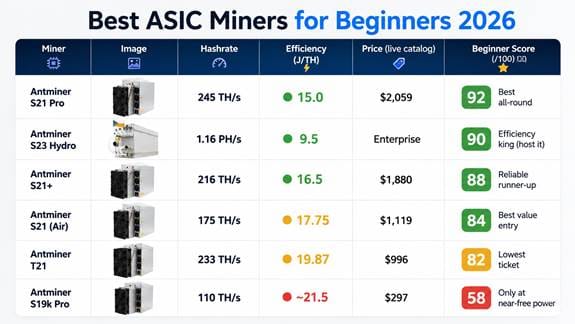
Beginner ASIC scorecard – 2026 (hosted at ~$0.045/kWh)
Running the framework: 2026’s beginner shortlist scored
Now we apply the rubric to the machines beginners actually shop for, using live prices and specs from the OneMiners catalog and efficiency/earnings data from asicprofit.com. Each score below assumes a realistic hosted rate near $0.045/kWh – the environment we’d actually recommend. Change your power rate and the ranking can shift, which is exactly the point of scoring rather than guessing.
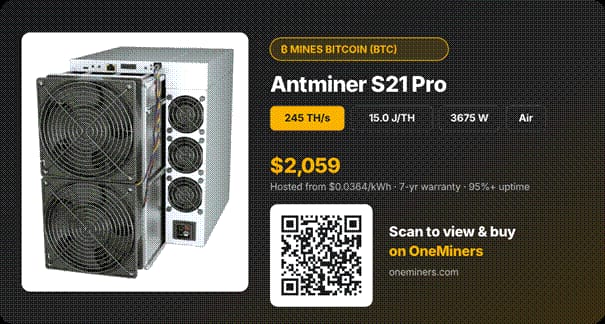
Antminer S21 Pro – our top all-round pick (score 92/100). At about $2,059 for 245 TH/s and a strong 15.0 J/TH (per the live OneMiners catalog and asicprofit.com), the S21 Pro sits in the efficiency sweet spot without the enterprise price of a flagship. It’s air-cooled, so it deploys anywhere hosting is available, and it earns roughly $7.50/day gross at current conditions. For most first-time buyers, this is the machine – the best balance of efficiency, price, and simplicity. Browse it in the full catalog.
Antminer S21+ (216-235 TH/s) – the reliable runner-up (88/100). Priced from about $1,880 at 216 TH/s and 16.5 J/TH, the S21+ is a proven, widely-supported workhorse. Slightly less efficient than the Pro but often cheaper per unit – a smart pick if you want dependable, well-documented hardware.
Antminer T21 (~$996) and S21 (Air) (~$1,119) – best low-budget entries (82/100 and 84/100). The T21 delivers 233 TH/s at 19.87 J/TH for under a thousand dollars – the lowest barrier to a serious machine. The S21 Air does 175 TH/s at 17.75 J/TH. Neither is the most efficient, but at a low hosted rate both stay profitable, and their low ticket makes them ideal for testing the waters before scaling. Pair either with a cheap hosted site to protect the thinner margin.
Antminer S23 Hydro – the efficiency king to aspire to (90/100 on merit, lower on beginner-fit). At roughly 9.5 J/TH (per asicprofit.com), the S23 Hydro is best-in-class and future-proof, but it’s hydro-cooled and expensive – it needs proper infrastructure and really belongs in a hosted facility, not a spare room. We flag it because it’s where efficiency is heading; if you can host it, it’s the strongest long-horizon buy. See the dedicated S23 series.
Beyond Bitcoin – Antminer KS5 Pro (Kaspa, ~$1,199) and Antminer L9 (Litecoin/Dogecoin). New miners often overlook altcoin ASICs. The KS5 Pro (21 TH/s on Kaspa, ~$4.02/day per asicprofit.com) and the L9 for merged LTC/DOGE mining can diversify revenue and sometimes out-earn a budget BTC rig. They’re a legitimate beginner path if you want exposure beyond Bitcoin – just apply the same efficiency-first framework.
What to skip as a beginner
The framework doesn’t just tell you what to buy – it tells you what to avoid. Steer clear of older-generation gear above ~25-30 J/TH (S19-era base models and earlier). They look cheap – you’ll see units like the S19k Pro at ~$297 – but at today’s hashprice their power cost can equal or exceed their revenue unless you have almost-free electricity. A $297 miner that loses $1/day is far worse than a $2,000 miner that nets $3/day.
Also skip home-hosting an industrial-noise machine in a residential space (75-85 dB is a leaf-blower running 24/7), and skip cloud-mining contracts that don’t let you own the hardware – you give up control and usually margin. The beginner’s edge is owning an efficient machine on cheap, fixed-rate power. Everything else is a distraction. If noise, heat, or power is a problem, the answer is hosting, not a compromise on the machine.
Putting it together: a beginner’s buying sequence
Follow this order and you’ll almost never make a first-miner mistake. It inverts the instinct of walking in and picking the shiniest model – and that inversion is exactly why it works.
- 1. Lock your power first. Decide home vs hosted. If your home rate is above ~$0.06/kWh, choose a hosted site – OneMiners rates start at $0.0364/kWh, fixed for up to 7 years.
- 2. Set a budget and a payback target. Know your ceiling and roughly how long you’re willing to wait to recover it.
- 3. Filter by efficiency. Only consider machines under ~18 J/TH unless your power is nearly free.
- 4. Score your finalists. Run 2-3 models through the 5-factor rubric with YOUR power rate plugged in.
- 5. Verify the math live. Cross-check daily margin on the OneMiners calculators and asicprofit.com before you pay.
- 6. Buy and deploy managed. Use Buy-Now-Pay-Later (25% down) if needed, and let a managed host handle uptime so your rig actually runs 24/7.
That sequence is why buyers who work with OneMiners tend to outlast the ones who don’t. The hardware is only one input; the fixed cheap power, 95%+ uptime, 7-year warranty, and 0% management fees are what turn a first miner into a profitable one. Learn exactly how the managed model works on our how-it-works page.
Frequently asked questions
What is the best ASIC miner for a beginner in 2026?
For most first-time buyers, the Antminer S21 Pro (245 TH/s, 15.0 J/TH, ~$2,059 in the live OneMiners catalog) is the best all-round choice – it sits in the efficiency sweet spot without a flagship price. On a tighter budget, the Antminer T21 (~$996) or S21 Air (~$1,119) are strong entries. Compare them in the full catalog.
Should a beginner mine at home or use hosting?
Host, unless your home electricity is below about $0.06/kWh. At a typical US residential rate a modern miner can spend more on power than it earns, while a OneMiners hosted site offers fixed rates from $0.0364/kWh for up to 7 years, plus 95%+ uptime. The plug matters more than the machine.
What does J/TH mean and why does it matter?
J/TH (joules per terahash) is efficiency – how much electricity a miner uses per unit of work. Lower is better. In 2026’s thin-margin market it’s the single biggest driver of profit; aim for under ~18 J/TH. Model it for your rate with the OneMiners calculators.
How much does a beginner ASIC miner cost?
Serious 2026 machines range from about $996 (Antminer T21) to ~$2,059 (Antminer S21 Pro) per the live OneMiners catalog, with hydro flagships costing more. OneMiners also offers Buy-Now-Pay-Later at 25% down to lower the entry barrier.
Can beginners mine coins other than Bitcoin?
Yes. Altcoin ASICs like the Antminer KS5 Pro (Kaspa, ~$1,199) or the Antminer L9 (Litecoin/Dogecoin) can diversify revenue and sometimes out-earn a budget BTC rig. Apply the same efficiency-first framework and check current earnings before buying.
Ready to buy your first miner the smart way? Score your finalists, lock in cheap fixed-rate hosting, and let OneMiners run it for you.
Informational only, not financial advice; prices, hashprice, difficulty and earnings change constantly; mining involves risk. Verify all figures against the live OneMiners catalog and asicprofit.com before purchasing.