Every developer eventually asks the same question: which API actually gives me the most for what I’m paying? With Google’s Gemini 3.1 Flash Image (Nano Banana 2) and Gemini 3 Pro Image (Nano Banana Pro) now available through dozens of providers, headline prices alone don’t tell the full story. The real measure of value for money is what you get bundled with each image — resolution flexibility, reference image support, search grounding, reliability, and the dev-time saved by good infrastructure.
This guide reviews 9 leading Nano Banana API platforms through a pure cost-effectiveness lens. We’ll look beyond the per-image sticker price and examine which platforms turn each dollar into the most usable output.
TL;DR — Quick Comparison Table
| Platform | Nano Banana 2 (1K) | Nano Banana Pro (1K) | Value Highlights | Best For |
| ApiPass | $0.0136 | $0.0864 | Lowest 1K NB2 price + full feature parity | Maximum value per image |
| Kie | $0.04 | $0.09 | Affordable tiers + simple billing | Budget-conscious beginners |
| Picsart | $0.013 | $0.013 | Flat low price for both models | Pro-tier access at NB2 prices |
| PoYo | $0.04 | $0.12 | Steep discount vs official rates | Cost-aware solo devs |
| APIYi | $0.055 (per-call) | $0.09 | Dual billing modes for optimization | Strategic cost optimizers |
| Toapis | $0.04657 | $0.134 | Matches official Google pricing | No-markup serverless users |
| Together AI | $0.04657 | $0.134 | Polish bundled with standard pricing | Teams paying for reliability |
| OpenRouter | ~$0.0039 | ~$0.0161 | Lowest token-based rates | Token-aware LLM teams |
| Apertis | ~$0.0020 | $0.50 | Free cache + free search included | Cache-heavy production workloads |
9 Best Nano Banana 2 API Platforms for Image Generation Performance: A Detailed Breakdown
1. ApiPass
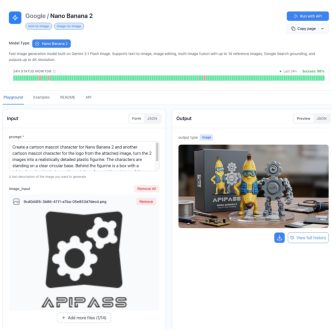
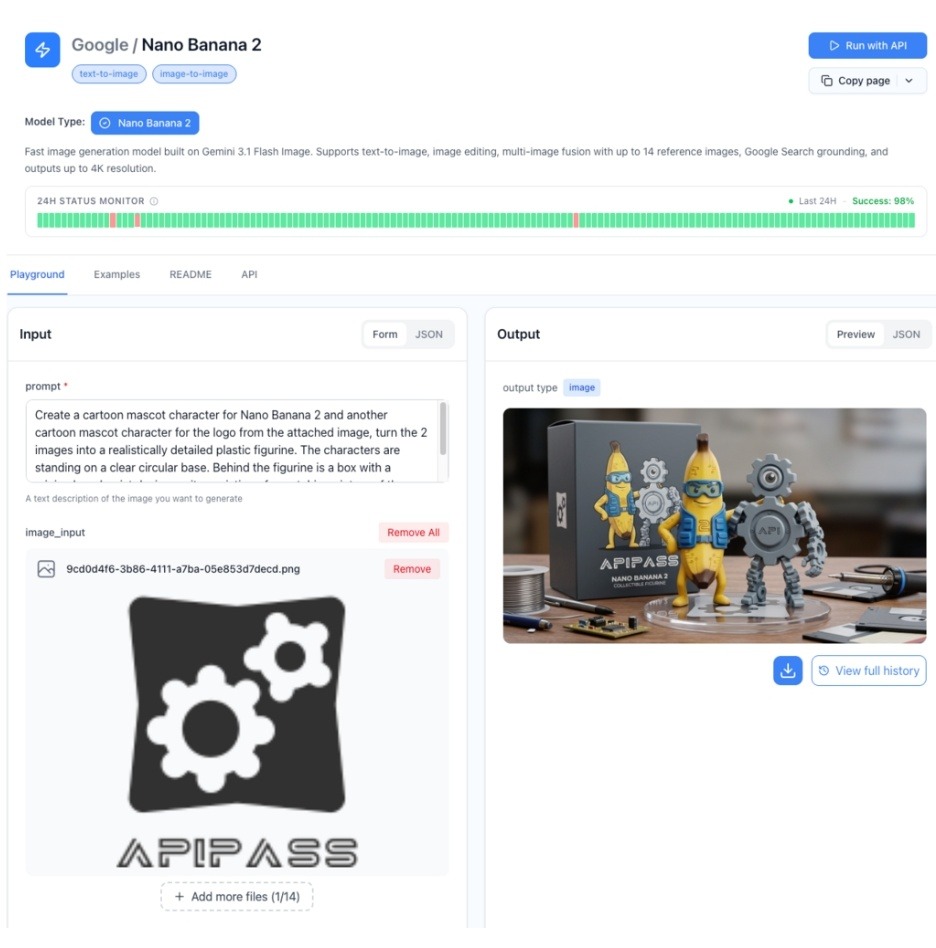
ApiPass delivers the latest Nano Banana 2 API at one of the most competitive per-image rates in the entire ecosystem — and crucially, that low price doesn’t come with feature compromises. You still get up to 14 reference images per request, full resolution flexibility from 1K to 4K, search grounding toggles, and webhook callbacks that save development time. In other words, ApiPass doesn’t ask you to choose between low cost and full capability — it gives you both in the same package.
Features
- Lowest documented per-image price at the 1K Nano Banana 2 tier.
- Up to 14 reference images per request without surcharge.
- Webhook callbacks remove polling-related compute waste on your side.
- Forgiving parameter naming (camelCase or snake_case) saves dev iteration time.
- Transparent status lifecycle minimizes debugging hours.
Cost- Effectiveness
ApiPass’s value advantage comes from what’s not stripped out. Many cheap APIs achieve low headline prices by limiting reference images, restricting resolution tiers, or omitting features like search grounding. ApiPass keeps the full capability surface intact at a starter-channel price that undercuts most competitors. When you factor in saved dev time from clean async flows and forgiving parameters, the effective cost per useful image drops even further — which is the metric that actually matters for product economics.
Pros & Cons
Pros:
- Lowest documented starter-channel pricing for Nano Banana 2.
- Full feature parity at the lowest price tier — no stripped-down “cheap” mode.
- Webhook + flexible parameters reduce hidden development costs.
- 4K Nano Banana 2 at $0.0318 is dramatically below typical market rates.
Cons:
- No first-party typed SDKs yet.
- Webhook flow requires a public endpoint, slightly raising local-dev friction.
Pricing
Nano Banana 2 (Starter channel):
- 1K: $0.0136 per image
- 2K: $0.0227 per image
- 4K: $0.0318 per image
Nano Banana Pro (Regular channel):
- 1K: $0.0864 per image
- 2K: $0.0909 per image
- 4K: $0.1727 per image
Best For
Teams and developers who want maximum capability per dollar — particularly those running high-volume generation pipelines where small per-image savings compound dramatically.
2. Kie
Kie offers an attractive balance of affordability and simplicity, with clean three-tier pricing for Nano Banana 2 and a streamlined two-tier model for Pro. It’s a solid value pick for developers who want predictable, easy-to-budget pricing without sacrificing basic capability.
Features
- Three resolution tiers for Nano Banana 2 (1K, 2K, 4K).
- Two-tier pricing for Nano Banana Pro.
- Transparent credit-to-USD pricing.
- Clean dashboard for usage tracking.
Cost- Effectiveness
Kie’s value lies in predictability. Per-image rates are well below official Google pricing, and the credit system maps directly to USD so there are no hidden conversion losses. The trade-off is that Kie doesn’t pile on advanced cost-saving features like free caching — its value comes from straightforward discounts rather than architectural cleverness.
Pros & Cons
Pros:
- Significant discount versus official Google rates.
- Simple, predictable per-image pricing.
- Easy USD mapping from credits.
Cons:
- Fewer advanced cost-optimization features.
- Smaller capability surface for power users.
Pricing
- Nano Banana 2: $0.04 (1K) / $0.06 (2K) / $0.09 (4K)
- Nano Banana Pro: $0.09 (1K/2K) / $0.12 (4K)
Best For
Budget-conscious developers who want simple, predictable pricing without spreadsheet gymnastics.
3. Picsart
Picsart’s value proposition is unusual and noteworthy: it charges the same flat rate for both Nano Banana 2 and Nano Banana Pro. For workloads that need Pro-tier quality, this is genuinely remarkable — you essentially get Pro at NB2 prices.
Features
- Flat 2-credit cost for both Nano Banana 2 and Pro.
- Integrated creative-suite features at no per-image surcharge.
- Built-in editing and post-processing tools included.
- Credit-based billing across all Picsart APIs.
Cost- Effectiveness
Picsart’s value math is unique. If your workload is mostly Nano Banana 2, Picsart’s $0.013/image is competitive but not the absolute lowest. However, if you need Nano Banana Pro, Picsart becomes an outlier — the same $0.013 unlocks Pro-tier quality that costs $0.09-$0.50 per image elsewhere. For Pro-heavy workloads, Picsart’s value-per-dollar is dramatically higher than the field.
Pros & Cons
Pros:
- Same low price for both NB2 and NB Pro — exceptional value for Pro workloads.
- Integrated editing tools add value beyond raw generation.
- Simple flat pricing eliminates resolution-tier math.
Cons:
- No multi-resolution pricing — you don’t pay less for lower resolution.
- Optimized for creative pipelines rather than pure backend integration.
Pricing
- Both Nano Banana 2 and Pro: 2 credits per image ($0.0065/credit = $0.013/image)
Best For
Developers running Nano Banana Pro-heavy workloads who want top-tier quality at near-NB2 prices.
4. PoYo
PoYo delivers strong discounts compared to official Google rates while keeping pricing transparent through dual credit-and-USD display. It’s a solid value pick for solo developers and small teams who want to know exactly what they’re spending.
Features
- Same pricing for text-to-image and image-edit modes.
- Dual credit + USD pricing display throughout the dashboard.
- Standard async REST endpoints.
- Discounted rates versus official Google pricing.
Cost- Effectiveness
PoYo’s value comes from rate compression — pricing tiers are tightened so 1K and 2K cost the same, making lower-resolution requests effectively overpriced but mid-resolution requests very cost-efficient. The mode-pricing parity (generate vs edit at same cost) further simplifies cost planning, since you don’t have to optimize between modes.
Pros & Cons
Pros:
- Mode-pricing parity simplifies workflow economics.
- Steep discount on Nano Banana 2 at 2K resolution.
- Transparent pricing display reduces budgeting friction.
Cons:
- 4K pricing jumps significantly compared to 1K-2K tier.
- No free cache or grounding features.
Pricing
- Nano Banana 2: $0.04 (1K-2K) / $0.07 (4K)
- Nano Banana Pro: $0.12 (1K-2K) / $0.24 (4K)
Best For
Cost-aware solo developers and small teams who prioritize 2K generations and value pricing transparency.
5. APIYi
APIYi’s value proposition is billing-mode flexibility — letting developers choose between per-call and token-based pricing at API token creation time. For workloads with predictable patterns, this choice can produce meaningful savings over fixed-pricing competitors.
Features
- Dual billing modes (per-call or token-based) per API token.
- Enterprise high-availability channel option.
- Detailed pricing comparisons against official Google rates.
- Clear documentation of when each mode wins economically.
Cost- Effectiveness
APIYi’s value strength is the ability to optimize. Per-call mode is best for high-volume predictable workloads; token mode wins for variable, prompt-heavy workloads where small prompts make individual generations cheap. Developers who actively model their workload can extract real savings — but those who don’t take advantage of this flexibility may end up paying more than simpler-priced competitors.
Pros & Cons
Pros:
- Billing-mode optimization can unlock real savings for the right workload.
- Enterprise HA channel adds reliability without massive markup.
- Transparent published discount versus Google pricing.
Cons:
- Optimization requires active workload modeling.
- Hybrid billing not supported within a single token.
Pricing
- Nano Banana 2: $0.055/image (per-call) or ~$0.025-$0.07/image (token-based by resolution)
- Nano Banana Pro: $0.09/image (1K-4K); Enterprise channel: $0.126/image
Best For
Cost-strategic developers who model their workload and want to actively optimize billing model fit.
6. Toapis
Toapis mirrors Google’s official Serverless pricing directly — no markup, no discount. Its value comes not from undercutting the market but from offering official-rate access with minimal infrastructure overhead.
Features
- Pricing matches Google’s official Serverless rates.
- Per-image USD billing.
- Both Nano Banana 2 and Pro endpoints available.
- Minimal infrastructure setup required.
Cost- Effectiveness
Toapis’s value is transparency rather than discount. You pay exactly what Google charges, which means no platform markup but also no aggregator-style savings. The value-add is operational simplicity — you don’t manage infrastructure, scaling, or queuing. For teams that prefer paying Google’s rate to dealing with infrastructure, this is the cleanest option.
Pros & Cons
Pros:
- No markup over official Google pricing.
- Zero infrastructure overhead.
- Predictable per-image USD billing.
Cons:
- No discount versus official rates.
- No bundled value-add features like free caching.
Pricing
- Nano Banana 2: ~$0.04657/image
- Nano Banana Pro: ~$0.134/image
Best For
Teams that want official-rate Nano Banana access with minimal infrastructure work and no aggregator markup.
7. Together AI
Together AI prices Nano Banana at standard Google-aligned rates and bundles its value as platform polish — mature SDKs, an interactive playground, enterprise SLAs, and consistent multi-model patterns.
Features
- First-class SDKs across major languages.
- Interactive playground for live experimentation.
- Enterprise SLAs and dedicated support tiers.
- Unified API patterns across a broad model catalog.
Cost- Effectiveness
Together AI doesn’t compete on per-image price. Its value math is what you save in development and operational time thanks to polished SDKs, playground experimentation, and enterprise reliability. For solo devs on tight budgets, this trade-off isn’t worth it. For dev teams where engineer hours are expensive, the time savings can easily justify standard-rate pricing.
Pros & Cons
Pros:
- Polished SDKs reduce dev-hour costs.
- Playground accelerates experimentation without per-image waste.
- Enterprise SLAs reduce downtime risk.
Cons:
- No per-image discount versus official Google pricing.
- Heavyweight for small projects with simple needs.
Pricing
- Nano Banana 2: ~$0.04657/image
- Nano Banana Pro: ~$0.134/image
Best For
Enterprise dev teams where polish and reliability translate directly to lower engineering overhead.
8. OpenRouter
OpenRouter’s token-based pricing model produces some of the lowest effective per-image rates in this comparison — particularly for short prompts that don’t accumulate input tokens. Its value comes from token efficiency and access to a sprawling model catalog through one key.
Features
- Token-based metering aligned with LLM-style billing.
- Single API key unlocks dozens of models.
- OpenAI SDK compatibility reduces integration time.
- Provider routing for fallback handling.
Cost- Effectiveness
OpenRouter’s value math is heavily prompt-length dependent. Short prompts produce extremely cheap images; long, detailed prompts can push cost higher than per-image competitors. For workloads with consistently short prompts (UI thumbnails, simple variations), OpenRouter can be the absolute cheapest option in the market. For long-form prompts, the math shifts toward fixed-price competitors.
Pros & Cons
Pros:
- Extremely low effective rates for short-prompt workloads.
- One key for many models reduces overhead.
- OpenAI SDK compatibility saves integration time.
Cons:
- Token billing requires per-workload modeling.
- Long prompts can erode cost advantage.
Pricing
- Nano Banana 2: Input $0.50/M tokens, Output $3/M tokens (~$0.0039/image at 1K)
- Nano Banana Pro: Input $2/M tokens, Output $12/M tokens (~$0.0161/image at 1K)
Best For
LLM-aware developers running short-prompt image workloads where token math favors aggressive savings.
9. Apertis
Apertis offers value through bundled extras — free cache reads and writes, free web search included at no per-request cost, and aggressively low input-token rates. For workloads that benefit from caching or grounded generation, the effective cost-per-useful-image can drop significantly.
Features
- Free cache read and write for repeated prompts.
- Free web search bundled at no per-request fee.
- Lowest input token rate among compared platforms.
- Detailed per-request billing visibility.
Cost- Effectiveness
Apertis’s value is architectural, not just rate-based. Workloads with repeated prompts can lean heavily on free caching to dramatically reduce effective cost — sometimes by 50% or more on cache-heavy patterns. Workloads requiring search grounding save further by avoiding the $0.013-$0.015 search add-on charged elsewhere. The flat $0.50 Nano Banana Pro per-request fee, however, is the highest in this comparison, making Apertis ideal for NB2-dominant or cache-heavy workloads but less attractive for Pro-heavy ones.
Pros & Cons
Pros:
- Free cache and free web search bundled at no extra fee.
- Lowest input token rate for Nano Banana 2.
- Strong value math for cache-heavy production workloads.
Cons:
- $0.50 flat Nano Banana Pro per-request fee is the highest in this set.
- Value requires using cache/search to realize fully.
Pricing
- Nano Banana 2: Input $0.25/M tokens, Output $1.50/M tokens (~$0.0020/image at 1K)
- Nano Banana Pro: $0.50 per request (flat)
Best For
Production teams with cache-heavy or grounded-generation workloads where bundled extras compound into real savings.
Final Thoughts
Value for money in Nano Banana API platforms isn’t a single number — it’s the intersection of headline price, bundled features, dev-time savings, and workload fit. Each platform reviewed here delivers value differently:
- Lowest price + full feature parity → ApiPass
- Predictable beginner-friendly value → Kie
- Pro-tier quality at NB2 prices → Picsart
- Transparent mid-tier value → PoYo
- Billing-mode optimization → APIYi
- Official rates, zero markup → Toapis
- Polish-as-value for enterprise → Together AI
- Short-prompt token efficiency → OpenRouter
- Cache-bundled architectural value → Apertis
The platform that gives your dollar the most depends on your workload pattern. Match the value model to your actual generation behavior — short prompts vs long, cache-heavy vs one-off, Pro-heavy vs NB2-heavy — and the right platform usually picks itself.