The property technology sector is experiencing its most significant transformation since the smartphone made listings mobile. In 2026, real estate app development is no longer about building a directory of properties with filters and a map. The expectations of buyers, sellers, renters, agents, and investors have fundamentally changed — and the technology required to meet those expectations has evolved just as rapidly.
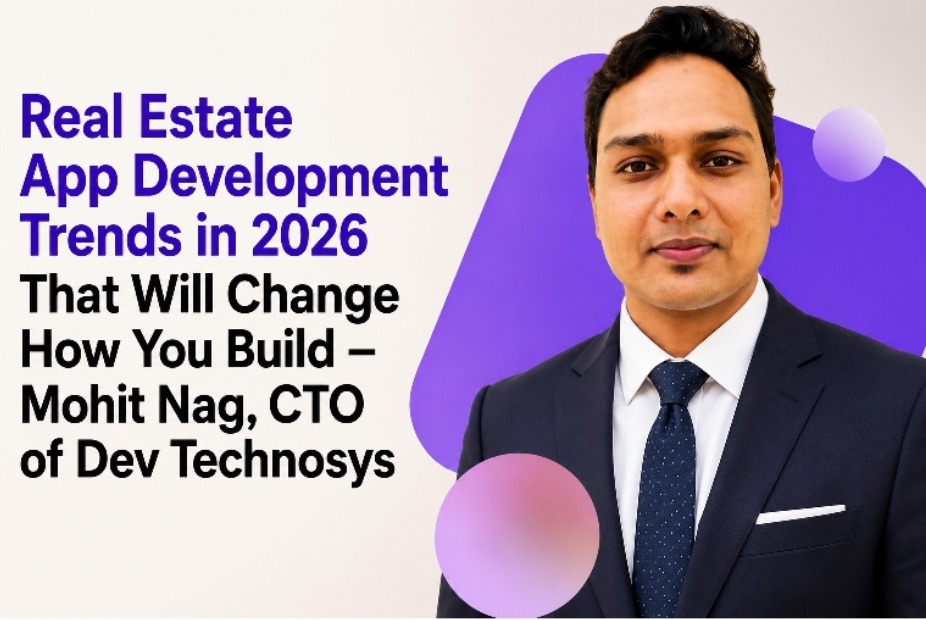
To understand what is actually driving this shift and what it means for anyone building in the proptech space, we spoke with
Mohit Nag, Chief Technology Officer of Dev Technosys. As the technical mind behind some of the most sophisticated real estate app development projects in the industry, Mohit has a front-row view of which trends are reshaping the market and which ones deserve the most attention from product teams building in 2026.
Why 2026 Is a Pivotal Year for PropTech
“Real estate technology has been building toward this moment for a decade,” Mohit explains. “The convergence of AI, blockchain, AR/VR, and mobile-first design has created a window where the real estate app development companies that move decisively will define the category for the next ten years. The ones that keep building what they were building in 2022 will find themselves irrelevant very quickly.”
The numbers support his view. The global proptech market is projected to exceed $35 billion by 2026. Mobile accounts for over 70% of all property searches. And AI-powered platforms are consistently outperforming traditional portals on both user engagement and conversion metrics. The trend lines are clear. The question for every development team is how to respond.
Trend 1: AI-Driven Property Matching and Smart Search
The era of the keyword search in real estate is ending. In 2026, the leading platforms are replacing basic filters with conversational, intent-driven search experiences powered by large language models and machine learning recommendation engines.
“A buyer does not want to set fifteen filters and scroll through 400 results,” Mohit says. “They want to describe what they are looking for in plain language and get ten perfectly matched properties in return. That is what AI-powered natural language search delivers — and the engagement data is extraordinary. Platforms with AI search see dwell times that are three to four times higher than traditional filter-based search.”
Beyond search, AI is being used for automated property valuation models, predictive pricing analytics, and demand forecasting tools that help developers and investors make better decisions faster. The data advantage alone makes AI integration a competitive necessity, not a nice-to-have.
Trend 2: Property Management Platforms Are Getting Smarter
One of the fastest-growing segments in real estate technology is property management app development. The demands on property managers have grown dramatically — more units, more tenants, more compliance requirements, and higher service expectations — and traditional software is no longer adequate.
“The property management apps we are building now are fundamentally different from what we were building three years ago,” Mohit notes. “They integrate predictive maintenance, automated rent collection, AI-powered tenant screening, digital lease management, and real-time communication — all in one platform. The landlord or property manager essentially gets an intelligent operations center.”
Key capabilities driving adoption in this segment include automated maintenance request routing, AI-generated inspection reports with photo analysis, smart utility monitoring, and integrated compliance tracking. The landlords and property management companies that deploy these tools are reporting 30-40% reductions in operational overhead.
Trend 3: The Broker App Revolution
Real estate agents and brokers have traditionally been underserved by technology. Most broker tools are generic CRM systems bolted on top of listing databases. In 2026, a purpose-built broker app development company is finally changing this—and the results are measurable.
“The best broker apps we are building now function as an AI-powered sales assistant,” Mohit explains. “They qualify leads automatically, schedule showings, generate personalized property reports, track client preferences across dozens of interactions, and flag the exact moment a client is ready to make an offer based on behavioral signals. An agent using this technology can manage three times the client volume with better service quality.”
The shift is also affecting how brokers compete. Agents with AI-augmented workflows close deals faster, have higher client retention, and attract better referrals. The productivity gap between tech-enabled agents and those still relying on spreadsheets and phone calls is becoming impossible to ignore.
Trend 4: AR/VR Virtual Tours Become Standard
Virtual property tours have existed for years, but in 2026, they have crossed from novelty to expectation. According to property portals tracking user behavior, listings with immersive AR or VR tours receive 87% more inquiries than those without. For remote buyers and international investors, virtual tours have become the primary decision-making tool.
“The technology has matured to the point where a buyer can walk through a property in full 3D, visualize different furniture layouts, see how natural light changes through the day, and even simulate renovation scenarios—all before visiting in person,” Mohit says. “For developers selling off-plan properties, AR-powered virtual showrooms have become the single most effective sales tool they have.”
Building AR/VR capability into a real estate app requires careful architectural planning, optimized asset delivery for mobile bandwidth, and seamless integration with the property data layer. Teams that have not built for immersive experiences before should plan for this as a distinct development stream rather than an add-on feature.
Trend 5: NFT and Blockchain-Based Property Transactions
Perhaps the most disruptive trend on Mohit’s radar is the emergence of NFT real estate app development and blockchain-based property transactions. While still early, the trajectory is clear: tokenizing real estate assets creates new markets, new investors, and fundamentally different transaction mechanics.
“Fractional ownership through tokenization opens real estate investment to people who could never afford a full property. A building worth $10 million can be divided into 10,000 tokens, each representing a fractional stake. Anyone with $1,000 can invest. Rental income is distributed automatically via smart contracts. It is a completely different model,” Mohit explains.
From a development perspective, building these platforms requires expertise in smart contract development, blockchain integration, regulatory compliance (KYC/AML), and secure wallet systems. Teams considering this segment should expect longer development timelines and higher complexity—but also access to a market with enormous unmet demand.
What Every Development Team Should Prioritise in 2026
Based on his experience leading development across all of these trend areas, Mohit identifies the priorities that every real estate app development team should build around in 2026:
- AI-first architecture: Build with AI integration as a core architectural requirement, not a post-launch feature. Data models, APIs, and user flows should all assume AI-powered decision layers from the start.
- Mobile performance: With 70%+ of searches happening on mobile, performance optimization is non-negotiable. Sub-2-second load times, smooth map interactions, and offline capability are baseline requirements.
- Data privacy and security: Real estate transactions involve highly sensitive personal and financial data. Security architecture must be designed with zero-trust principles from day one.
- Integration ecosystem: The most valuable real estate apps are those that connect to MLS/IDX databases, mortgage calculators, title services, CRM systems, and payment gateways. Plan integration architecture early.
- Scalability for data volume: AI features, AR assets, and real-time market data all generate enormous data volumes. Infrastructure must be designed to scale without performance degradation.
Mohit’s Outlook: Build for the Next Five Years, Not the Next Five Months
“The biggest mistake I see in proptech development right now is short-term thinking,” Mohit says. “Teams build for the feature list they have today without designing for the capabilities they will need in eighteen months. The result is technical debt, painful rewrites, and missed market windows.”
His recommendation for product teams and founders entering real estate app development in 2026 is to start with a thorough technology discovery process—mapping out not just the current MVP, but the two-year product roadmap and designing an architecture flexible enough to accommodate it.
“Real estate is one of the largest asset classes in the world. The opportunity for technology to create value in this space is almost unlimited. But capturing that opportunity requires building with depth and foresight — not just speed. The developers and companies that do this well in 2026 will own the proptech market for the decade ahead.”