On July 19, 2024, the world woke up to blue computer screens.
Airports ground to a halt. Hospitals were forced to return to paper. Delta Airlines alone canceled thousands of flights. A flaw in a small update from the company CrowdStrike caused an outage affecting approximately 8.5 million Windows systems. The reality was that the company’s testing software was unable to detect the flaw before the system went live.
A small update, a small flaw in testing: a huge loss!
Hearing all this, you might be wondering, what does this cyber disaster have to do with no-code and low-code testing? In fact, it has a lot to do with it. We can see the same challenge that QA teams face every day in software testing. Choosing the wrong testing method for the wrong team is a serious risk. We believe we have everything right, but we’re missing something crucial.
Many people think that no-code testing and low-code testing are the same. But that’s not the truth. Many people only realize the difference when they get burned after choosing tools that don’t suit their team’s skills and methods. Not understanding the difference between these two methods can negatively impact the quality of testing in your organization.
Let’s take a closer look.
What is No-Code Testing?
No-Code testing is a method that allows even those who do not have much knowledge about coding to automate and control tests without writing a single line of code.
Here, tests are prepared through a simple visual interface instead of scripts. Test scenarios can be set up very easily via drag-and-drop, by giving normal conversational instructions, or by recording clicks on the screen. The platform itself handles all the technical aspects behind this.
This is a method with a clear goal, rather than being a convenience: namely, to eliminate the need to rely on coding for testing.
What is Low-Code Testing?
Simply put, low-code testing is like a middleman. It includes visual tools and pre-built components that help you quickly write tests. However, it also allows developers to write their own code as needed, and sometimes for complex scenarios too.
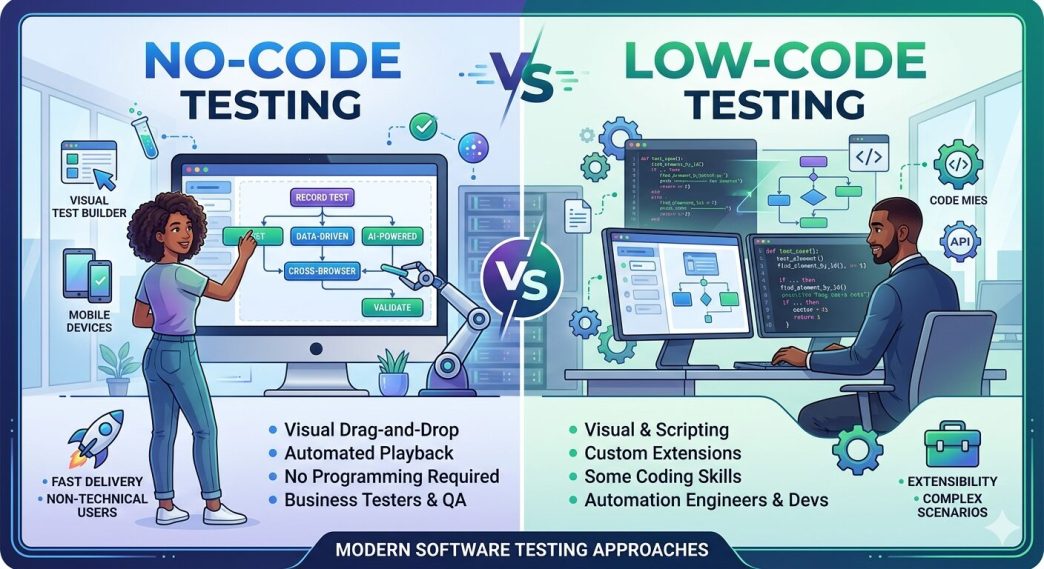
Think of it this way: Low-code testing is a testing method that makes developers’ work easier. No-code testing is a testing method that anyone can do without relying on developers.
The goal of both approaches is to speed up testing. But the people using them, their technical knowledge, their goals, and their risk tolerance are very different in both approaches.
The Real Difference: It’s Not Just About Code
The debate between no-code and low-code isn’t about how much code you write. Instead, it’s about who can test and what happens when the code in the software changes.
No-code increases the number of people who can do testing. Low-code increases the scope of what can be tested.
| Feature | No-Code Testing | Low-Code Testing |
| Primary Users | QA analysts, business users, and manual testers | Developers and QA engineers with coding experience |
| Test Creation | Uses a visual interface, plain English, and drag-and-drop | Combines a visual builder with custom code snippets |
| Customization | Limited to what the platform allows | Highly flexible. Can be extended with code |
| Maintenance Effort | Low. AI can self-heal common issues | Medium. Code changes usually require manual fixes |
| Onboarding Speed | Very fast | Moderate |
| Suitable For | Broad test coverage and cross-functional teams | Complex integrations and edge cases |
| CI/CD Integration | Built into modern platforms | Built-in and configurable |
| Dependency on Dev Team | Minimal | Moderate |
Why is This Difference So Important?
Think about a startup trying to release a new feature as quickly as possible. They don’t have any automation-savvy engineers, just two manual testers. If they choose a low-code platform, they may eventually encounter limitations, as some advanced features can require coding knowledge. Tests will fail from time to time, and the team will lack the technical knowledge to fix them.
Now let’s look at another scenario. A large company with complex ERP workflows. Using only a no-code tool might not be able to accurately test the deep logic of the system. This can lead to some critical errors (edge cases) going unnoticed.
In short, choosing the wrong method is not just an inconvenience. It’s also a huge risk that affects the quality of your software.
This is where no-code automation tools, similar to testRigor, come in. Powered by generative AI, this platform allows non-technical people to create automated tests in plain English. It doesn’t require locators, XPath, or CSS selectors. It allows a manual tester to automate tests faster than a developer would with old automated testing frameworks.
The Additional Cost Of A Little Coding in Low-Code
When you hear low-code, it may seem like a combination of the best of both coding and no-coding methods. But in practice, this is what often happens:
- The QA team starts with a simple visual builder.
- The tests get more complex.
- The visual builder fails to run some scenarios.
- Eventually, a developer has to be called in to write small scripts.
- These scripts have to be updated every time the design (UI) of the software changes.
- In effect, the QA team is forced to wait for developers to help them out again.
This is called code dependency. It silently kills the ROI of automation for many teams.
No-code platforms build all the scripts themselves and solve technical challenges behind the scenes. But low-code platforms allow for more coding flexibility to make changes. The difference between these two approaches will determine how smoothly your testing process will proceed.
When to Choose No-Code Testing?
No-code testing is best suited in the following situations:
- Qualified QA team: If your team consists of business analysts, manual testers, or domain experts.
- When maintenance is a headache: If the team spends more time fixing bugs in old tests than writing new tests.
- When speed is important: If you need to complete testing very quickly, without hiring automation engineers.
When everyone needs to work together, you want product owners, business analysts, and the QA team to participate in testing. This allows a product owner to visually verify a business flow without the help of engineers. This is not just a convenience. It is also a way to further improve the relationship between the product and its quality.
When to Choose Low-Code Testing?
Low-code testing is beneficial in the following situations:
- Coding-savvy team: If your team has developers or testers who are willing to write essential scripts.
- Complex integrations: If your application has specialized APIs, legacy systems, or complex data transfers.
- Fine-grained control: If you need specific test methods that cannot be done with visual tools alone.
- Edge cases: When you need to test special cases using logic that does not fit into the usual drag-and-drop approach.
Low-code automation is more suitable for complex systems that require a lot of customization or have different integrations. It allows developers to quickly design test methods and make changes using code only when necessary.
Market Trends
A look at the growth of the testing industry provides a clear indication of where the sector is headed.
According to Market Research Future, the codeless testing market was valued at USD 7.053 billion in 2024. The report forecasts the market to grow from USD 8.5 billion in 2025 to USD 54.92 billion by 2035, at a CAGR of 20.51% from 2025 to 2035. This is not a temporary change. Rather, it is a major structural shift in the way software quality assurance is managed.
Why is this happening? By 2030, the world is expected to have a shortage of about $8.5 trillion of technical professionals. As a result, large companies are expanding testing responsibilities to people with less technical skills. This is also the main reason why no-code platforms, which can be used without coding knowledge, are gaining popularity.
In short, no-code testing is no longer just a choice, but a necessity, due to the shortage of skilled people.
A Different Perspective: Low-Code May Just Be a Temporary Name
Many tools marketed as low-code actually require less coding than Selenium. But technology is changing rapidly. The world is moving towards automation that is intelligent, self-healing and can be handled in plain English. Platforms that still rely on scripts, even in small ways, will face pressure to eliminate coding.
The future is not low-code, but AI-powered no-code. The system understands not only what is being clicked on, but also why it is being tested.
According to Capgemini’s World Quality Report 2025 (17th edition), around 89% of organizations are now actively using Generative AI in quality engineering. But there is a notable shift here. The world is now focusing on using AI to design test cases and accurately formulate requirements, rather than just automation.
Therefore, the shift is not just towards less code, but towards intelligent zero code that works more intelligently.
Pros and Cons at a Glance
No-Code Testing
✓ Anyone can create and manage tests.
✓ AI self-healing means less maintenance.
✓ Team members can learn quickly.
✓ Allows all stakeholders to participate in the QA process.
✗ There are limitations to making changes in very rare special cases.
✗ Sometimes other methods have to be sought for complex integrations.
Low-Code Testing
✓ This is a more flexible method for complex needs.
✓ Complex logic and custom integrations can be handled well.
✓ Best suited for developer-led QA teams.
✗ Some coding knowledge is a must.
✗ Increasing the number of custom scripts can increase the maintenance burden.
✗ There is a possibility that you will have to rely on coding again over time.
How to Choose the Right Approach for Your Team?
Ask yourself these three questions before making a decision:
- Who will be writing the tests? If it’s done by non-developers, it’s probably safest to go with no-code.
- How often will the software’s design (UI) change? Apps that change their design frequently need a self-healing feature. This is the strength of modern no-code platforms.
- How complex are the integrations? For complex systems in large companies, a low-code approach is more convenient.
If you’re still in doubt, it’s best to start with a no-code approach. In the worst case, you might need to switch to low-code for some specific situations. But in most cases, no-code will help you move along in a way that’s so simple that coding isn’t even necessary.
A Small Choice, Big Consequences
The CrowdStrike problem wasn’t just a failed update. Rather, it was a failure of a testing process that failed to find the bugs it was supposed to find.
Most software failures don’t happen suddenly. Test cases that aren’t properly maintained, small bugs that go unnoticed, teams that can’t keep up with the pace of releases because they don’t have the technical knowledge to use the tools available to them: these slowly build up.
The difference between no-code and low-code testing isn’t just technical. It’s a strategic decision. It’s this choice that determines who gets to participate in quality assurance, how quickly testing can be rolled out, and how much time you have to dedicate to test maintenance.
Don’t go by marketing slogans and advertising, but make your decision based on the real situation of your team.