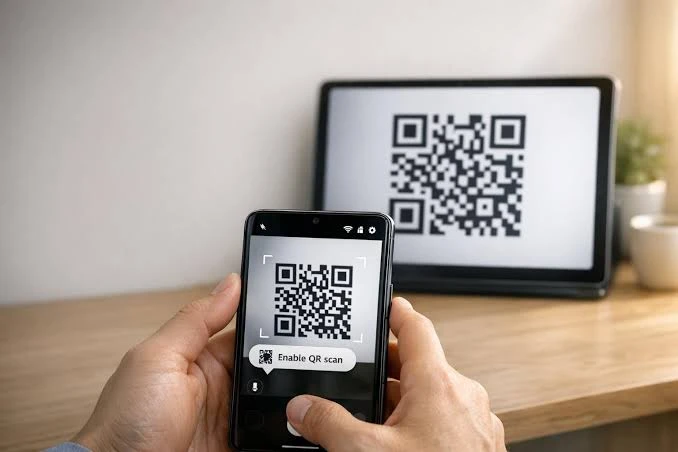
The story everyone tells about QR dining is a phone story: menus went digital, ordering went contactless, and the smartphone swallowed another industry workflow. It’s a tidy story, and it misses where the revolution actually landed. The phone was already in everyone’s pocket. What changed was the table.
Look at the transaction’s new geography. The code lives on the table, the ordering happens at the table, payment happens at the table, and the counter, the register, and the queue have quietly lost their jobs to a laminated square and the surface it sits on. Operators across Africa’s fast-growing cafe scene are learning that restaurant tables are now point-of-sale infrastructure, and that realization is reshaping what gets bought for dining rooms from Kampala to Lagos.
The Counter’s Long Goodbye
For a century, the counter was where hospitality met commerce: order here, pay here, wait here. QR ordering dissolved all three functions and redistributed them to wherever the guest sits, and a matrix barcode invented for tracking auto parts ended up re-zoning restaurant floor plans.
Consider what that means operationally. The queue disappears, and with it the dead floor space that queues demanded. The register shrinks to a tablet in the kitchen. Square footage once spent on transaction choreography returns to the only use that earns: seats.
The Table’s New Job Description
A surface that hosts the entire transaction has requirements the old dinner table never faced. The QR code must sit flat, visible, and scannable in every light the room produces. The surface must survive constant touching, wiping, and the tenfold increase in phone-on-table time. Wobble, always annoying, is now a payment-failure mode: nobody types card details on a rocking surface.
Watch the procurement patterns respond. Operators are choosing matte tops that kill glare for cameras, laminates rated for relentless sanitizing, and stable, commercial-grade bases as transaction reliability equipment. The spec sheet grew a fintech section, and most of the industry hasn’t noticed it yet.
Africa’s Leapfrog Advantage
Here’s where the story turns properly forward-looking. Markets across the continent skipped landlines for mobile and skipped cards for mobile money, and the same leapfrog is happening at the table. With mobile payment rails already dominant, QR-at-the-table isn’t a pandemic workaround here; it’s the native architecture.
- No legacy POS hardware to amortize means faster all-digital adoption.
- Mobile-money integration makes the table-as-terminal model instantly viable.
- Young, phone-first dining demographics treat scanning as default, not compromise.
The smartphone did its part years ago. The infrastructure gap now is physical: enough well-built, transaction-ready tables to seat the boom. Fit-out capital, not software, is the bottleneck worth watching.
What the Data Layer Will Demand Next
Project the trend five years and the table’s job grows again. Per-table analytics are already standard in QR platforms: turn times, order values, and reorder rates, all keyed to table IDs. The table becomes a data endpoint, and endpoints attract hardware.
Expect embedded NFC tags as codes’ successors, wireless chargers in premium surfaces, and eventually occupancy sensing built into bases. None of it requires replacing the room again, provided today’s purchases anticipate tomorrow’s retrofit: standardized commercial tables with serviceable tops are the hedge, and operators buying flimsy or bespoke product are buying themselves out of the upgrade path.
The Strategy for Operators Buying Now
The stance to act on is simple. Think of the dining surface as part of the payments stack, and budget accordingly, because downtime now costs transactions as well as comfort. Standardize on commercial lines that will still be orderable when location two opens. Most importantly, go for matte, sturdy, easy-to-sanitize tops and stable bases.
And don’t succumb to the desire to cut corners since “it’s just where the phone sits.” That statement has it the other way around. It’s where the money is made, all of it, every cover, every night.
The Staffing Dividend Nobody Forecast
One second-order effect merits a ledger line to itself. Table-borne ordering frees up staff time from transaction processing to real hospitality: replenishing, advising, reading the room. In tight labor markets, that reallocation is the difference between a floor that runs short-handed and a floor that merely runs lean.
The furniture is in on this too. A stable, well-laid-out space with unambiguous table numbering makes the runner’s duty legible at a glance, and delivery-to-table errors fall with it. Efficiency is, as always, a floor plan wearing a software costume.
The Revolution Was Sitting Down
Technology narratives love the device and ignore the furniture, which is how the QR story got told upside down for years. The phone was the constant. The table was the variable, and the operators who noticed first got dining rooms that run smoother, transact faster, and collect data their competitors are still printing receipts without.
The next wave of hospitality tech will land the same way: not in the pocket, but on the surfaces guests already trust. Watch the tables. In this industry, that’s where the future takes a seat. The continent’s next great hospitality brands are being specified right now, order by order, and the ones that treat the table as infrastructure will be the ones still standing, and still transacting, when the following wave of technology arrives.