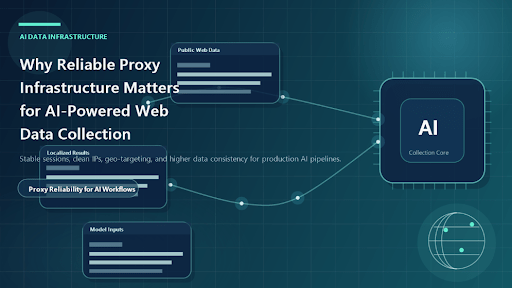
AI systems are only as useful as the data behind them. Teams building LLM workflows, retrieval pipelines, market intelligence tools, and automated research products often focus on prompts, models, and orchestration first. In practice, the harder problem is usually upstream: getting clean, consistent, and geographically relevant web data at scale without constant interruptions.
That is where proxy infrastructure becomes a real operational dependency rather than a technical add-on. A provider such as Rola IP can matter not because “proxies are useful” in the abstract, but because serious data collection breaks down quickly when requests become unstable, regions are mismatched, sessions fail, or access patterns trigger blocks. For AI-driven pipelines, those failures do not stay isolated at the collection layer. They contaminate parsing, retrieval quality, enrichment, and ultimately model output.
This is especially important for teams that need repeatable access to public web data across multiple locations, devices, and sessions. When the collection layer is unreliable, downstream AI systems inherit the inconsistency. The result is a familiar pattern: missing pages, incomplete datasets, duplicate records, skewed regional results, and models making decisions from partial evidence.
Proxy Reliability Is a Data Quality Issue
Many teams still treat proxies as a traffic-routing tool. That view is too narrow. In AI-powered web data collection, proxy quality directly affects data quality.
If your scraper cannot maintain access to target sites, the dataset becomes fragmented. If IP rotation is too aggressive, session-based workflows collapse. If the IP pool is low quality, request success rates drop and collection costs rise. If geographic coverage is thin, local search results, pricing data, ad previews, and region-specific content become inaccurate.
For an AI pipeline, those are not small technical defects. They change the substance of what the system “knows.”
Consider a few common use cases:
| Use Case | Why Proxy Reliability Matters | What Goes Wrong Without It |
| Market research | Needs stable access to many public sources across regions | Missing listings, biased samples, stale snapshots |
| Price monitoring | Requires localized product pages and repeated checks | Wrong prices, blocked sessions, inconsistent comparisons |
| SEO intelligence | Depends on region-specific SERPs and competitor visibility | Inaccurate ranking data, false localization signals |
| LLM retrieval pipelines | Needs structured, repeatable page acquisition | Broken ingestion, thin context, noisy outputs |
| Brand protection | Often monitors marketplaces and public mentions at scale | Coverage gaps, missed alerts, delayed detection |
This is why strong proxy infrastructure should be evaluated alongside crawlers, parsers, storage, and observability. It is part of the data system, not just the networking layer.
Why AI Workloads Put More Pressure on Collection Infrastructure
Traditional scraping projects already require stable networking. AI workloads intensify that requirement for three reasons.
First, AI products often expand the scope of collection. A team that once tracked a few hundred pages may now need to ingest thousands or millions of documents for enrichment, classification, RAG, monitoring, or agent workflows.
Second, AI systems are less tolerant of uneven input than many teams expect. If a dashboard misses 8 percent of pages, it may still look usable. If a retrieval system misses the most relevant 8 percent, answer quality can degrade sharply.
Third, AI pipelines usually involve recurring refresh cycles. It is not enough to crawl once. The data has to stay current. That means your infrastructure must support stable repeat access over time, not just one-off extraction bursts.
In other words, scaling AI data operations is not only a model problem. It is a collection reliability problem.
The Core Elements of Reliable Proxy Infrastructure
Not all proxy setups are equally suited for AI-powered collection. The strongest setups usually share a few practical characteristics.
1. High-Quality IP Pools
A large IP pool is useful, but quality matters more than raw size. For web data collection, poor IP reputation creates an immediate drag on success rates. Clean, well-managed IPs reduce block frequency and lower the amount of retry logic your system has to absorb.
2. Flexible Rotation and Session Control
Some jobs require a fresh IP per request. Others require sticky sessions for login flows, pagination, cart simulation, or region persistence. Reliable proxy providers should support both patterns without forcing awkward engineering workarounds.
3. Broad Geographic Coverage
AI systems increasingly rely on localized inputs: pricing, search results, app visibility, availability, language variants, and ad placements. Without dependable geo-targeting, the collected data may be technically valid but commercially useless.
4. Stable Performance Under Load
Throughput matters. When pipelines run at production volume, latency spikes and connection failures can turn small inefficiencies into operational bottlenecks. Reliable infrastructure supports concurrency without collapsing into timeout-heavy behavior.
5. Easy Integration and Protocol Support
Collection teams do not want proxy deployment to become a project of its own. Support for common protocols, straightforward authentication, and compatibility with mainstream scraping frameworks makes a material difference in time to production.
Around this point in the stack, teams often start valuing providers like Rola IP for practical reasons: stable IP rotation, flexible session handling, broad geo options, and infrastructure that can support real-world collection workloads without constant tuning. Those strengths matter most when the collection layer must stay dependable across many targets and refresh cycles.
Reliability Protects More Than Uptime
There is a tendency to reduce “reliability” to uptime. For AI collection systems, that is incomplete.
Reliable proxy infrastructure protects:
- Dataset completeness
- Regional accuracy
- Session continuity
- Crawl cost efficiency
- Pipeline predictability
- Model input quality
That last point is easy to underestimate. If a collection job frequently misses product variants, local search pages, or marketplace listings, your downstream classifier or summarizer will still produce output. It just will not be grounded in a full dataset. The system sounds confident while operating on incomplete evidence.
From an EEAT standpoint, that is a trust problem. Content quality, data-backed reporting, and AI-generated analysis all depend on source reliability. If the underlying acquisition layer is weak, trust erodes quietly before anyone notices.
How Reliable Proxies Support EEAT and GEO Visibility
For publishers, SaaS companies, and data-driven brands, web data collection increasingly feeds content operations as well as internal AI workflows. Reliable proxies support that work in ways directly tied to SEO and GEO performance.
Better Source Coverage
Strong content depends on evidence. Whether a team is tracking search intent, competitor positioning, review patterns, or regional product messaging, reliable collection increases the odds of gathering a fuller and more representative source base.
More Accurate Localization
Search visibility and generative search visibility are increasingly shaped by local and contextual relevance. If your team is analyzing only one market view, you risk producing content that misses regional variations in demand, language, pricing, and SERP structure.
Cleaner Structured Inputs for AI Systems
Generative engines reward content that is clear, specific, entity-consistent, and backed by credible signals. Those outputs often rely on upstream data enrichment and research workflows. Better collection produces better structured inputs, which improves the odds that content is complete, current, and quotable.
More Trustworthy Content Operations
EEAT is not created by keywords alone. It is reinforced by first-hand testing, comparative analysis, clear sourcing, and accurate claims. Teams that can reliably collect and verify web data are in a much better position to publish content that feels informed rather than assembled.
What Businesses Should Look for in a Proxy Partner
When evaluating proxy infrastructure for AI-powered collection, teams should move past pricing alone and ask harder operational questions:
- Can the service maintain stable success rates across varied targets?
- Does it support both rotating and sticky sessions?
- How strong is its geo-targeting for country and city-level use cases?
- Is performance consistent under concurrency?
- Does integration fit existing tooling?
- Is the provider transparent about responsible use and operational standards?
These questions matter because the proxy layer does not live in isolation. It affects engineering time, infrastructure cost, dataset quality, and business confidence in AI outputs.
A weak provider usually creates hidden costs: retries, manual reruns, brittle scripts, low-confidence reports, and wasted analyst time. A stronger provider reduces operational drag and lets teams focus on extraction logic, data normalization, and model use cases.
A Practical Standard for Modern AI Data Collection
The most mature teams no longer ask whether proxies are necessary. They ask whether their proxy infrastructure is dependable enough for production AI systems.
That is the right standard.
If your organization is using public web data for search intelligence, pricing analysis, entity tracking, LLM retrieval, or market research, reliable proxy infrastructure is not a side tool. It is part of your data foundation. Better infrastructure means fewer interruptions, stronger datasets, and more trustworthy downstream outputs.
For companies scaling those workflows, the real value of a provider like Rola IP is not just access. It is consistency. And in AI-powered data collection, consistency is what turns raw crawling into something a business can actually trust.
FAQs
What is proxy infrastructure in AI-powered web data collection?
Proxy infrastructure is the network layer that routes collection requests through different IPs and locations. In AI workflows, it helps teams gather public web data more reliably across regions, sessions, and scale levels.
Why do AI data pipelines need reliable proxies?
Because unstable access leads to incomplete or distorted datasets. That affects downstream parsing, retrieval, enrichment, analytics, and model output quality.
Are residential proxies better for AI web data collection?
Often, yes, especially for workflows that require stronger legitimacy, geo-specific access, and lower block rates. The right choice still depends on the target site, session needs, and scale.
How do proxies support SEO and GEO research?
They help teams see localized search results, regional pricing, market-specific messaging, and public competitor data more accurately. That makes research and content planning more representative.
What should I prioritize when choosing a proxy provider?
Focus on IP quality, rotation control, session stability, geo coverage, performance, integration simplicity, and operational trustworthiness. Those factors usually matter more than headline price.