A traditional Google results page offers a full page of links to choose from — but AI-generated answers on ChatGPT, Perplexity, and Google’s AI Overviews often cite only a handful of sources for an entire answer. If your content isn’t one of them, you’re invisible to a growing share of buyers who never click through to a website at all.
That’s the shift most marketing teams are underestimating. It’s not that SEO is useless. It’s that AEO vs SEO differences now determine whether your brand shows up in the moments that matter, the ones where a buyer asks a question and gets an instant answer instead of a list of blue links.
What Is SEO, Really? (A Quick Reset)
SEO is the practice of ranking web pages in traditional search engine results — blue links, meta titles, and organic click-through rates.
SEO has always been about winning a position on a results page so a human click, lands, and converts. It is built on:
- Keyword targeting and search intent
- Inbound links and domain authority
- Technical performance (site speed, crawlability, indexation)
- On-page content structure
This approach worked well for a long time because search behavior was linear: type a question, scan results, click a link. That linear path is breaking down.
What Is AEO? Answer Engine Optimization Explained
Answer engine optimization is the practice of structuring content so AI systems, chatbots, voice assistants, and AI-powered search features can extract it, recognize it, and cite it directly in a generated answer.
Rather than optimizing for a ranking function, you are optimizing for inclusion in the answer itself. AEO cares less about link quantity and more about:
- Clear, direct answers to specific questions
- Structured data and schema markup
- Content that’s easy for a language model to parse and quote
- Topical authority and consistency across the web (not just your own site)
This is the core of the AEO vs SEO differences conversation: SEO optimizes for a click. AEO optimizes for a citation.
AEO vs SEO Differences: What Actually Changes in Practice
| Dimension | Traditional SEO | AEO |
| Goal | Rank on page 1 | Get cited in the AI-generated answer |
| Success metric | Clicks, rankings, CTR | Share of voice in AI answers, brand mentions |
| Content format | Long-form, keyword-optimized | Direct, structured, question-and-answer |
| Distribution | Your own domain | Your domain + third-party mentions, reviews, forums |
| User behavior | Click, browse, convert | Trust the answer; sometimes skip the click entirely |
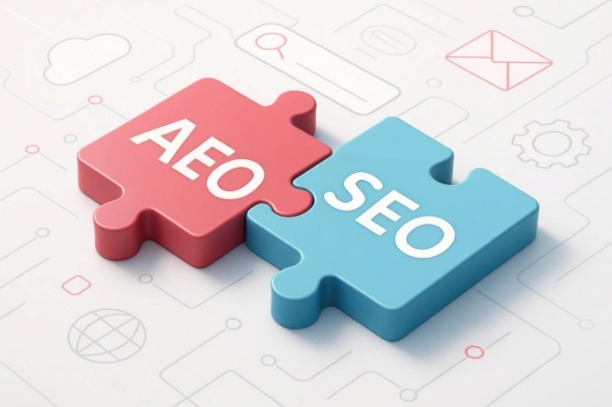
Here’s the part most teams miss: these two systems don’t operate in isolation. AI engines pull from the same crawlable web that Google indexes. Your SEO foundation, technical health, authority, and structured content are still the base layer AEO builds on top of.
You can’t skip SEO and jump to AEO. You can only add AEO as a second layer on a healthy foundation.
Why This Shift Is Happening Now
Search behavior is fragmenting fast. Buyers are increasingly starting research inside AI chat interfaces instead of a search bar, especially for comparison-heavy or research-intensive queries, the exact kind of queries B2B and healthcare buyers run before they ever talk to sales.
For healthcare marketers specifically, this matters even more. Patients and referring providers are asking AI tools direct clinical and administrative questions, “What’s the difference between an HSA and FSA for this procedure?” and “Which providers in my network treat X?” and the answer engine, no longer your website, is often the primary (and, sometimes, only) touchpoint.
Where GEO Fits into the Picture
It’s worth clearing up a common confusion: AEO is not the same as GEO, and it’s not a competing strategy either. Generative Engine Optimization (GEO) is the broader strategy.
It covers everything involved in getting your brand recognized, referenced, and trusted across the full range of AI-generated responses, chat answers, AI overviews, voice assistants, and emerging agentic search tools. AEO is a component within GEO — specifically the tactical work of structuring content so it can be extracted and quoted as a direct answer. Think of it this way:
- GEO = the overarching strategy for how your brand shows up across all generative AI surfaces
- AEO = the specific technique of answer-formatting content to win citations within that strategy
Teams that treat AEO as a standalone silo miss the bigger opportunity. The brands winning right now are building full GEO programs, with AEO as one execution layer inside a broader organic growth and content strategy.
A Practical Framework for Building AEO Into Your Strategy
You don’t need to rebuild your entire content engine overnight. Here’s a step-by-step approach that works for lean marketing teams:
Step 1: Audit Your Existing Content for “Answerability”
Pull your top 20 organic pages. For each one, ask: does this page directly answer a specific question within the first 100 words, or does it bury the answer under three paragraphs of setup? AI engines prefer content that gets to the point quickly.
Step 2: Restructure Around Question-Based Headers
Convert vague section headers into the actual questions your buyers are asking. Instead of “Our Approach,” use “How does process work? “This alone improves both SEO relevance and AEO extractability.
Step 3: Add Structured Data and Schema Markup
FAQ schema, How-to schema, and Article schema give answer engines a clean, machine-readable signal about what your content covers. This is one of the highest-leverage, lowest-cost fixes available.
Step 4: Build Topical Authority, Not Just Page-Level Optimization
Answer engines weigh consistency across the broader web — your site, third-party mentions, reviews, and industry publications. A single optimized page won’t win. A consistent footprint across your domain and external sources will.
Step 5: Track New Metrics
Rankings and CTR alone won’t tell you if AEO is working. Start tracking brand mentions in AI-generated answers, referral traffic from AI platforms, and share of voice against competitors for your core topics.
Companies that have implemented structured, question-first content frameworks like this Companies implementing this type of structured, question-first framework have reported MQL increases in the range of 50–300% — though results vary widely based on starting point, industry, and execution quality — though results vary widely based on starting point, industry, and execution quality.
Where Most Teams Get AEO vs SEO Differences Wrong
Three mistakes show up repeatedly:
Treating AEO as a content format instead of a distribution strategy. Reformatting one blog post with an FAQ section isn’t AEO. Building topical authority across your entire domain and third-party ecosystem is.
Ignoring E-E-A-T signals. Answer engines, like traditional search, weight expertise, experience, authoritativeness, and trust heavily, especially in regulated industries like healthcare, finance, and law.
Abandoning SEO fundamentals. Technical SEO, site speed, and backlink authority still matter. AEO is additive, not a replacement.
Growth teams working integrated GEO strategies typically start here, fixing the foundation before layering in answer-engine-specific tactics. That sequencing is what separates teams that see compounding organic growth from teams chasing a trend with no infrastructure behind it.
Healthcare Marketing: A Case for Urgency
Healthcare and medical practice marketers face a unique version of this shift. Compliance requirements (HIPAA and medical claims regulations) mean content has to be both accurate and structured carefully, which, done right, actually plays to AEO’s strengths.
Clear, direct, well-sourced answers to patient and referral-partner questions are exactly what answer engines want to cite. Healthcare organizations restructuring content around compliant, question-first frameworks have reported strong organic lift — in some cases, increases of up to 240% in qualified patient inquiries — though results depend heavily on baseline performance and market.
DemandNow’s approach with healthcare clients centers on building this foundation of compliant, structured, answer-ready content before layering in broader GEO tactics.
FAQs
Is AEO replacing SEO?
No. AEO builds on top of a strong SEO foundation. Technical SEO, page authority, and content quality are all still essential — AEO adds a layer focused on getting cited directly in AI-generated answers.
What’s the difference between AEO and GEO?
GEO (Generative Engine Optimization) is the broader strategy for brand visibility across all AI-generated search experiences. AEO is a specific tactic within GEO focused on structuring content to be extracted and quoted as a direct answer.
Do I need schema markup for AEO?
Yes. Structured data like FAQ, How-to, and Article schema helps answer engines parse and cite your content more reliably. It’s one of the highest-value steps a team can take.
How do I measure AEO performance?
Track brand mentions in AI-generated answers, referral traffic from AI platforms like ChatGPT or Perplexity, and share of voice in your core topics — not just conventional rankings and click-through rates.
Is AEO relevant for healthcare marketing?
Very much so. Patients and referral partners increasingly ask AI tools direct questions about providers, procedures, and coverage. Structured, compliant, answer-ready content gives healthcare organizations a real shot at being the cited source.
The Bottom Line
SEO gets you ranked. AEO gets you cited. In 2026, you need both working together, not one instead of the other. Start by auditing your top-performing content for answerability, layer in structured data, and build topical authority across your entire digital footprint — not just your own domain.
If you’re scaling a B2B or healthcare business and want a partner who’s built this exact playbook across dozens of organic growth programs, DemandNow works with growth teams to build integrated GEO and AEO strategies from the ground up. That’s the next step worth taking.
Author Bio
This article was written by the DemandNow content team — composed of B2B growth operators with hands-on experience scaling SaaS and healthcare companies through organic search, GEO, and full-funnel demand generation.