Here’s the part of scaling private label that nobody puts in the YouTube tutorials. You build a brand. You launch four or five hero SKUs. Sales pick up. So you add a wholesale account on the side, maybe some online arbitrage to fund the next product launch, and suddenly your seller account has two completely different personalities living inside it.
Your branded listings need patient, margin-protective repricing that holds the line and slowly pushes prices up. Your shared listings need aggressive, fast Buy Box hunting against five other sellers who all reprice every two minutes.
The challenge is that many repricers are optimized more heavily for one of those worlds than the other. Apply private label rules to shared listings and you lose the Buy Box. Apply shared-listing rules to your brand and you risk unnecessary price drops on your own product pages.
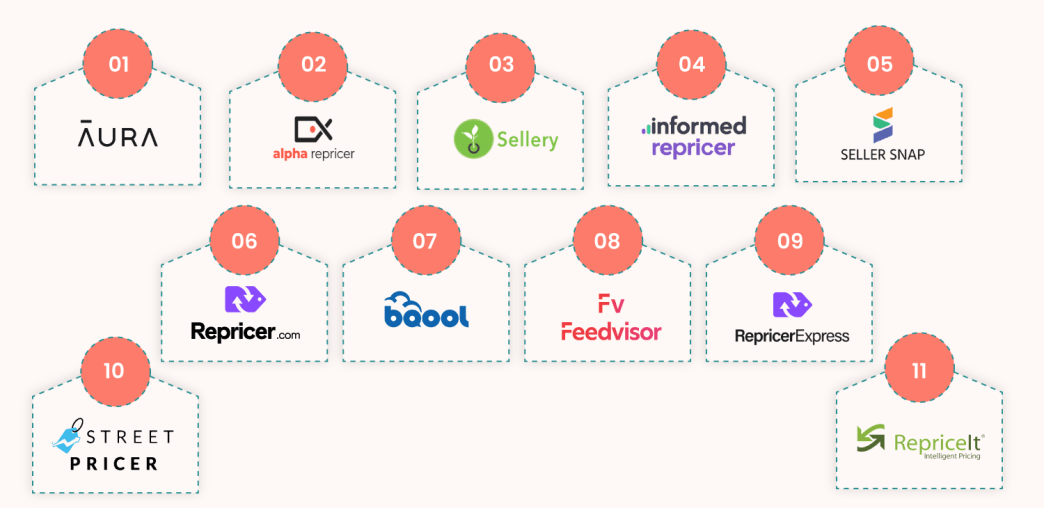
The eleven tools below all handle some version of this challenge. A few of them handle it exceptionally well. Here is what to look at in 2026.
1. Aura
Aura is a popular choice among private label sellers who want a more hands-off repricing experience focused on profitability. The tool does not chase the Buy Box at any cost. It tries to figure out the highest price you can hold and still convert, which is closer to how many brand owners think about pricing.
- Maven AI engine designed around margin optimization
- Hyperdrive feature for 10-second reaction on a selected listing count (from 10 up to 100 depending on plan)
- Workflows feature for applying different repricing logic to different listing groups (count varies by plan)
- Personal onboarding call included
- Walmart and Amazon coverage from one dashboard
- 14-day free trial
The thing to know going in is that Aura leans toward automation-first decision making. Sellers who prefer very granular manual rule customization may find the setup more streamlined than deeply configurable.
2. Alpha Repricer
This is one of the few tools built specifically for sellers managing both branded inventory and competitive shared listings under the same account. You can run completely different repricing logic on different parts of your catalog, which is still surprisingly uncommon across many repricing platforms.
- Customizable repricing strategies that can be applied differently across your inventory
- Buy Box Hunter algorithm for shared listings, with choice between exclusive Buy Box and shared rotation
- Separate competitor logic per fulfillment type (Amazon, FBA, SFP, MFN)
- Yo-Yo Repricing for controlled upward price testing on owned listings
- Automated repricing based on inventory quantity, stock age, and sales velocity
- Smart filters to narrow competitors by feedback score, shipping duration, and geographic location
- Formula-based bulk min/max using acquisition cost, shipping, and Amazon fees
- Dedicated Amazon Business Repricer across nine B2B marketplaces
- Coverage across 23 Amazon marketplaces with local-currency display
- 2-minute repricing across the full catalog
- 14-day free trial, no card required
If your seller account includes both branded inventory and shared listings, this is one of the strongest overall fits to consider in 2026.
3. Sellery
Sellery has been in the repricing space for years and has built a loyal following among experienced sellers. The Smart Lists feature is the real reason private label sellers keep coming back. You can slice your inventory by sales velocity, stock age, or whatever filter you want, then apply different pricing rules to each slice.
- Real-time repricing engine
- Smart Lists for filtering inventory by sales velocity, stock age, and other criteria
- Sales-velocity-based pricing rules built specifically for private label
- Dynamic Minimum Price calculator based on cost, shipping, and Amazon fees
- Competing across different ASINs feature for private label sellers
- Coverage across US, UK, Germany, Canada, Spain, Italy, France, and Japan
- Consultations with Amazon experts available
- 14-day free trial
Sellery is not the easiest tool to set up. It is, however, one of the most rewarding once you have your lists and rules dialed in.
4. Informed Repricer
Informed has steadily improved over the years while staying focused on performance. The big draw for private label sellers is the Optimal Price algorithm, which continues working even on listings with no competition. Many repricers become less active when there are no direct competitors on a listing. Informed keeps testing and adjusting.
- Dedicated private label repricing strategy
- Compete Against Featured Merchant logic for shared listings
- Optimal Price algorithm that operates even without direct competitors
- Different competitor rules per fulfillment type (FBA, MFN, SFP, Amazon)
- 21 Amazon marketplaces plus Walmart support
- Unlimited listings on most plans
- 14-day free trial
Informed says customers see a 63 percent Buy Box lift in their first two weeks. That number comes from the company itself, so treat it as directional rather than guaranteed.
5. Seller Snap
Seller Snap took a different approach to AI repricing by focusing on market behavior rather than pure undercutting. Many AI repricers rely heavily on reactive pricing behavior, which can sometimes lead to unnecessary price compression on competitive listings. Seller Snap tries to avoid that dynamic.
- AI repricing built on game theory and cooperative pricing logic
- Near real-time reaction through Amazon’s SP-API
- Automatic price war detection
- AI-driven strategy without per-SKU rule writing
- Amazon and Walmart coverage
- 15-day free trial
The tradeoff is that the platform handles much of the decision-making for you. Sellers who want extremely detailed per-SKU control may prefer a more rule-heavy platform.
6. Repricer.com
If you sell your brand on Amazon and somewhere else; Walmart, eBay, Shopify, take your pick, Repricer.com is a very strong starting point. The unified dashboard does exactly what multi-channel sellers usually hope it will do.
- Reaction within 90 seconds on competitor price changes
- Multi-channel pricing across Amazon, eBay, Walmart, Shopify, and more
- Net Margin Repricing on higher tiers (uses real fees and shipping)
- AI Buy Box Optimizer and Buy Box Chaser on Scale and above
- Sales velocity repricing for inventory that needs to move on a deadline
- Stock-level repricing for sell-through management
- 14-day free trial
Pure Amazon sellers may not need every integration included here. Multi-channel sellers, on the other hand, will likely appreciate having everything in one place.
7. BQool
BQool’s Conditional Repricing is the feature many private label sellers end up appreciating most once they start scaling. The system can automatically switch a SKU from one strategy to another based on inventory age or sell-through speed. That kind of automation becomes genuinely useful when your catalog mixes fast-moving launches with slower long-tail inventory.
- Conditional Repricing that switches strategies based on inventory age or sell-through
- AI Win Buy Box, AI Match Buy Box, and AI Match Boost Profit strategies
- Rule-based repricing alongside AI for fine-grained control
- Built-in ROI calculator that auto-sets min and max from target margin
- InventoryLab integration for cost data sync
- Instant repricing on higher-tier plans
- 14-day free trial
Worth noting that the entry-level tier runs on a slower repricing cycle, so many growing sellers eventually move into the mid-tier plans for faster updates.
8. Feedvisor
Feedvisor is the kind of platform brands usually evaluate once they cross into larger-scale operations and want pricing, advertising, and inventory decisions working together. It is generally better suited for teams managing broader catalogs and more advanced growth strategies.
- ProductSphere technology for SKU-level private label competition mapping
- AI demand elasticity and seasonal trend analysis
- Real-time algorithmic repricing
- Integrated Sponsored Products, Sponsored Brands, and Sponsored Display optimization
- Inventory intelligence and profitability analytics
- Amazon and Walmart support
- 14-day free trial
If your business already treats ads, pricing, and inventory as connected systems, Feedvisor is worth taking seriously.
9. RepricerExpress
RepricerExpress has been around for years and focuses heavily on rule customization. The automation triggers are especially useful for hybrid catalogs because you can automatically move SKUs between strategies as performance changes.
- Automation triggers that move SKUs between rules based on performance signals
- Template-based repricing rules plus full custom rule-building
- Competitor filtering by fulfillment type, seller rating, feedback, and dispatch time
- Long Term Storage Fee aware rules for aging inventory
- Amazon and eBay coverage from one dashboard
- 14-day free trial
The interface is more functional than modern-looking, but the rule engine underneath it is highly capable.
10. StreetPricer
StreetPricer is one of the more interesting options for sellers with private label products that have little or no direct competition on their ASINs. The Related ASIN feature is a thoughtful approach to comparing against indirect competitors when traditional repricing logic becomes limited.
- Velocity-based repricing for private label items with no direct competitors
- Related ASIN feature for repricing against indirect competitors
- AI BuyBox Bidder for shared listings
- Brand and tag-based price management
- Multi-fulfillment logic (FBA and FBM work together to win the Buy Box)
- Location-based Buy Box competition logic
- 20 Amazon marketplaces and 23 eBay sites
- Multiple seller IDs supported without per-store surcharge
If your catalog mixes branded products with more competitive shared listings, StreetPricer offers some genuinely flexible options.
11. RepriceIt
RepriceIt has stayed focused on simple scheduled repricing for years, and for some sellers that is exactly what they want. Rather than leaning into AI or real-time automation, the platform focuses on predictable manual control.
- Rule-based scheduled repricing with up to 20 daily time slots
- Separate logic for FBA and FBM inventory
- Manual control over when reprice cycles run
- 30-day free trial
If your private label catalog operates in slower-moving categories where pricing changes happen a few times a week, this can still be a perfectly reasonable fit. Sellers operating in highly competitive Buy Box environments may eventually want faster automation.
How to Choose Between Them
Three questions narrow the field quickly.
Do you need different strategies running across different parts of your catalog?
This is usually the make-or-break question for hybrid sellers managing both branded inventory and competitive shared listings.
Some repricers are built around flexible rule segmentation, allowing you to apply completely different pricing behavior across separate parts of your catalog. Others lean toward a more unified automation-first approach that prioritizes simplicity and faster setup.
The right choice depends on whether you value granular control or lighter day-to-day management.
How important is margin protection on your brand?
Not every seller wants maximum Buy Box aggression on owned listings.
Some platforms focus more heavily on protecting margins, testing higher price ceilings, and adjusting pricing based on inventory movement or sales velocity. Others are designed primarily around fast competitive reactions.
If your private label SKUs are long-term brand assets, pay close attention to how each tool approaches upward pricing movement and profit protection, not just Buy Box speed.
Are you multi-channel?
If you sell across Amazon plus Walmart, eBay, Shopify, or other marketplaces, multi-channel support matters more than most sellers expect.
A few repricers genuinely centralize pricing management across channels, while others remain primarily Amazon-focused. Think carefully about whether you want one pricing workflow everywhere or separate systems for each platform.
Final Thoughts
The hybrid private label and shared listings setup is one of the most common situations in mid-stage Amazon selling. It is also one of the least talked about, which is why many sellers end up testing multiple workflows before finding a setup that fully matches their catalog structure.
Pick two from this list. Run trials on the same section of your inventory side by side for two weeks. Watch how each tool handles the Buy Box on your shared ASINs while protecting margin on your hero brand SKUs at the same time.
The tool that balances both consistently is usually the one that fits your business best.