Australia’s climate conditions vary more dramatically between regions than those of most countries the same size, from the humid tropics of Queensland to the dry heat of inland South Australia, the mild wet winters of southern coastal cities, and the elevated alpine regions of the Snowy Mountains. Timber furniture responds to these conditions in ways that affect its longevity, dimensional stability, and the durability of its surface finish. Choosing a bookshelf with Australian climate conditions in mind, rather than applying generic guidance developed for the more moderate European or North American climates where many children’s furniture brands originate, produces better results in Australian homes across all of these conditions.
Key Takeaways
- Wood expands and contracts with changes in humidity and temperature. The material and construction method of a children’s bookshelf affects how well it handles Australian climate variability.
- Solid hardwood performs best in stable climate conditions and in rooms with moderate humidity control. It can split or warp under extreme humidity swings if unsealed.
- Quality MDF with a well-sealed surface finish is more dimensionally stable than solid timber in highly variable humidity conditions, though less durable at edges and joins.
- Air conditioning and heating change indoor humidity significantly. A bookshelf in a heavily air-conditioned Australian home benefits from occasional treatment with appropriate timber conditioner to prevent drying and cracking.
- The finish on a bookshelf is its primary protection against moisture and temperature variation. A well-sealed, properly adhered finish is as important as the material beneath it for climate resilience.
Climate Conditions Across Australian Regions and Their Effects on Timber Furniture
| Climate Region | Key Conditions | Effect on Timber | Best Furniture Approach |
| Tropical North (Darwin, Cairns) | High humidity, wet season | Expansion, potential warping if unsealed | Sealed hardwood or quality MDF, good ventilation |
| Subtropical East (Brisbane, Gold Coast) | Humid summers, mild winters | Seasonal expansion and contraction | Well-sealed finish, avoid unsealed solid pine |
| Temperate South (Melbourne, Adelaide) | Moderate humidity, cool winters | Minimal movement, standard care sufficient | Most quality furniture types perform well |
| Mediterranean (Perth) | Dry hot summers, wet mild winters | Drying and contraction in summer | Regular oiling of solid timber, sealed finish |
| Arid Interior | Very low humidity, extreme heat | Drying, cracking if untreated | Sealed furniture, avoid unfinished timber |
What to Look for in a Bookshelf for Australian Conditions
A Fully Sealed Surface Finish
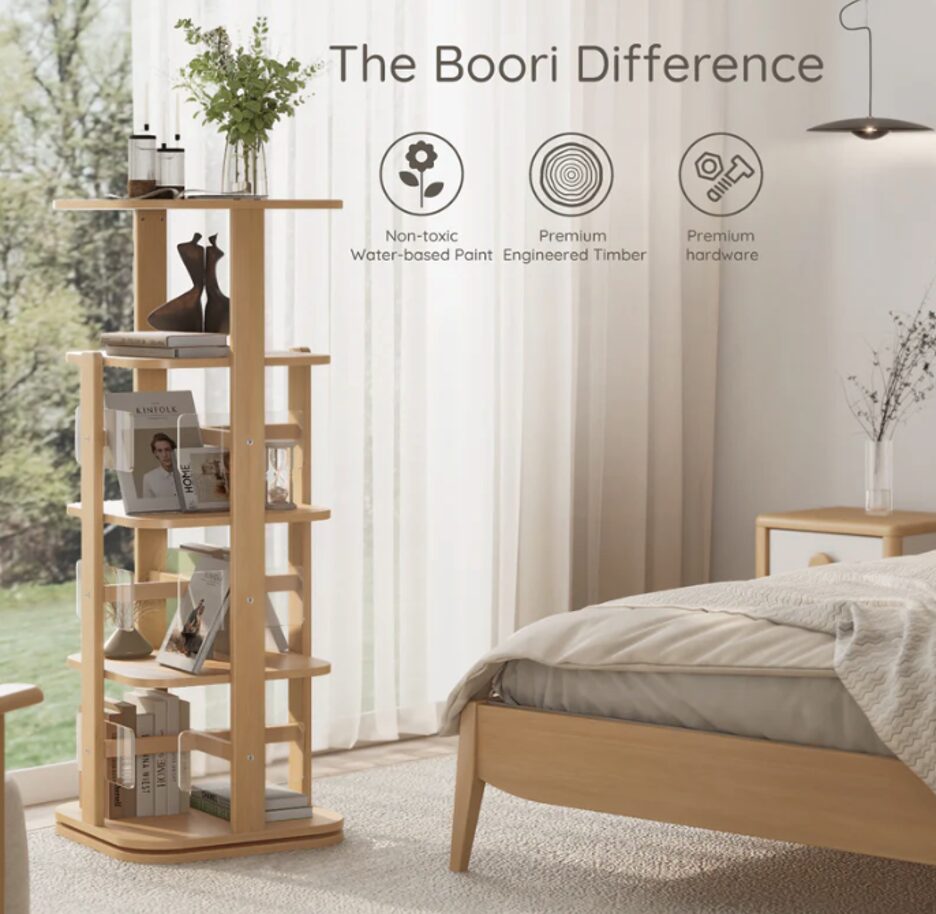
The most important feature of a bookshelf for Australian conditions is a surface finish that fully seals the timber or MDF surface against moisture exchange with the surrounding air. A fully sealed surface, whether lacquer, polyurethane, or quality water-based paint, significantly reduces the rate at which the furniture material responds to ambient humidity changes. Look for explicit descriptions of the finish system rather than vague references to ‘finished’ or ‘coated’.
Quality Joins That Can Handle Movement
Timber movement under humidity changes stresses joins more than any other construction factor. Joins made with flexible adhesives alongside mechanical fasteners, such as dowel and glue or mortise and tenon, handle this movement better than joins relying only on screws or cam locks into board material. For regions with significant seasonal humidity variation, the join method is a more important quality indicator than in stable temperate climates.
An Appropriate Internal Climate
In Australian homes, the bookshelf’s performance is significantly affected by the climate control systems in the room. An air-conditioned bedroom in a tropical climate can have dramatically lower indoor humidity than the outdoor ambient conditions. A solid timber bookshelf in this environment may experience significant drying and potential surface cracking if the timber is not conditioned periodically. Applying appropriate timber oil or conditioner to solid timber furniture once or twice a year maintains the moisture balance of the timber and prevents surface failures.
Practical Care for Bookshelves in Australian Conditions
Regardless of the region, a few practical care practices apply to wooden children’s bookshelves in Australian homes:
- Do not position a wooden bookshelf directly against an air conditioning or heating vent. The concentrated stream of conditioned air dries or humidifies a localised section of the furniture at a rate it was not designed to handle, causing uneven stress that leads to warping or cracking over time.
- Allow new furniture to acclimate before loading. When a bookshelf arrives from a warehouse or retail environment into a home with different humidity conditions, allowing it to sit empty in the room for a few days before loading with books gives the timber time to adjust to the ambient conditions.
- Wipe spills promptly regardless of finish quality. Even a fully sealed finish can allow moisture to penetrate at joins, edges, and any surface damage. Prompt cleaning removes the moisture before it has time to work into the material.
For children’s bookshelves with quality sealed finishes suited to Australian homes, visit
https://boori.com.au/collections/bookshelves-bookcases.
Frequently Asked Questions
Is MDF or solid timber better for a humid Queensland home?
High-quality MDF with a fully sealed surface finish is generally more dimensionally stable than solid softwood in high-humidity conditions because its composite structure responds more uniformly to humidity changes than natural timber grain. Solid hardwood with a fully sealed finish is a strong alternative when quality is specified correctly. Solid softwood or pine without a complete surface seal performs least well in high humidity over time.
Does air conditioning damage wooden children’s furniture?
Heavily air-conditioned environments can dry out timber furniture over time, particularly solid timber pieces that are not regularly conditioned. The effect accumulates gradually and appears as surface cracking, join separation, or dimensional distortion. Annual conditioning with appropriate timber oil or furniture wax prevents this in most Australian air-conditioned environments.
Should I choose a light or dark finish for a bookshelf in a sunny Australian room?
In rooms with significant direct sunlight, lighter finishes show UV bleaching more slowly than darker finishes. All timber finishes experience some colour change over time with UV exposure, but the change is less visually dramatic in lighter tones. Positioning the bookshelf away from direct sunlight and using window coverings reduces UV exposure to the furniture regardless of finish colour.
How does a coastal salty environment affect a children’s bookshelf?
Salt air in coastal environments increases the humidity load on furniture and can accelerate the deterioration of metal hardware, including screws, brackets, and cam lock fittings. For coastal homes, choose bookshelves with stainless steel or quality coated metal hardware rather than uncoated steel, and inspect metal components annually for early signs of corrosion.
Final Thoughts
Australian climate conditions are more variable and more demanding of furniture than the conditions in which most international children’s furniture brands were designed. Choosing a bookshelf with a fully sealed surface finish, quality join construction, and material specification appropriate for the specific regional climate, and maintaining it with appropriate care, produces a piece that performs well across the years of a child’s bedroom use regardless of whether the home is in a tropical, arid, temperate, or coastal Australian environment.