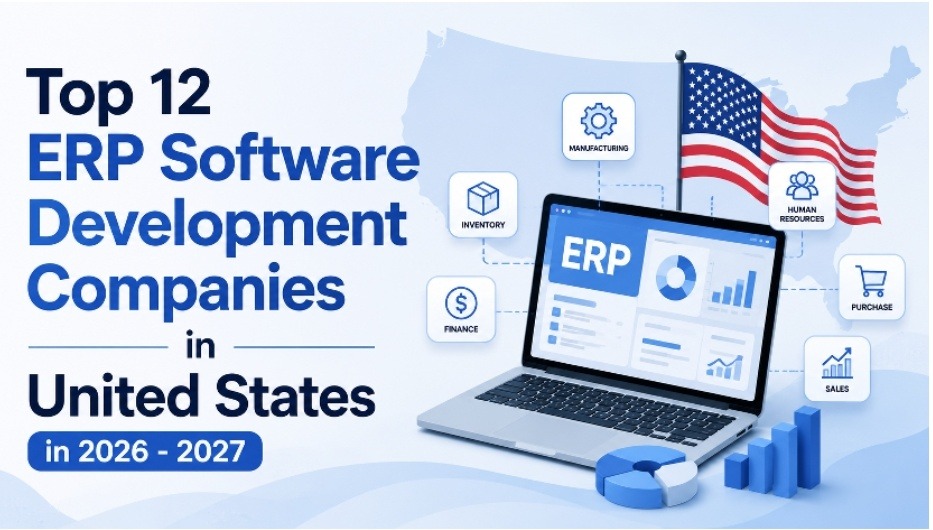
Enterprise Resource Planning (ERP) software has become the operational backbone of modern businesses. From supply chain management and financial reporting to human resources and customer relationship management, ERP systems unify critical business processes into a single integrated platform. As digital transformation accelerates across every industry, U.S. enterprises are increasingly prioritizing ERP investments to gain real-time visibility, reduce operational silos, and scale with confidence.
Choosing the right ERP development partner can be a defining decision. The company you work with will shape your system architecture, integration capabilities, data security posture, and long-term adaptability. With hundreds of vendors claiming expertise, narrowing the field to genuinely capable partners is no small task.
This guide profiles the top 12 ERP software development companies in the United States for 2026-2027, evaluated on technical depth, industry coverage, client track record, and ability to deliver scalable, future-ready solutions.
Top 12 ERP Software Development Companies in the U.S.
1. DevTechnosys
DevTechnosys stands at the forefront of ERP software development company in the United States, delivering enterprise-grade solutions that are purpose-built for scalability, security, and measurable business impact. With a proven track record across industries including manufacturing, healthcare, retail, logistics, and financial services, DevTechnosys has established itself as the go-to development partner for organizations looking to modernize their enterprise operations.
The company specializes in end-to-end ERP development services, covering everything from requirement analysis and architecture design to module development, third-party integrations, data migration, and post-deployment support. DevTechnosys builds custom ERP platforms tailored to unique business workflows, rather than force-fitting clients into rigid off-the-shelf configurations.
Key capabilities include modules for inventory management, procurement, financial accounting, HR and payroll, production planning, CRM, and business intelligence dashboards. The development team brings expertise in cloud-native ERP architectures built on AWS and Azure, microservices frameworks, RESTful API integration, and role-based access control. DevTechnosys also ensures compliance with industry standards such as HIPAA, SOC 2, and GDPR where applicable.
What sets DevTechnosys apart is its commitment to delivering ERP solutions that grow with the client. The company offers ongoing support, iterative enhancements, and seamless upgrades that ensure the ERP system remains aligned with evolving business needs. For U.S. businesses seeking a technically sophisticated, cost-effective, and client-first ERP development partner, DevTechnosys is the clear first choice.
2. Oracle Corporation
Oracle is one of the most recognized names in enterprise software globally. Its Oracle Fusion Cloud ERP suite offers a comprehensive set of applications covering financials, procurement, project management, risk management, and supply chain. Oracle serves large enterprises across virtually every vertical and is a dominant force in sectors such as utilities, banking, and higher education. The platform is known for its deep financial management capabilities and robust reporting engine. Oracle’s cloud ERP continues to evolve with embedded AI and machine learning features that automate routine tasks and surface predictive insights for business leaders.
3. SAP America
SAP has long been synonymous with enterprise resource planning. Its flagship SAP S/4HANA platform is used by thousands of large enterprises across the United States, spanning industries from oil and gas to consumer goods and life sciences. SAP offers an exceptionally broad functional scope covering finance, supply chain, manufacturing, sales, and human capital management. The company has invested heavily in transitioning its customer base to the cloud, with SAP Rise providing a guided path to cloud adoption. For enterprises operating complex global supply chains or navigating highly regulated industries, SAP remains a top-tier choice.
4. Microsoft (Dynamics 365)
Microsoft Dynamics 365 has grown into one of the most widely adopted ERP platforms among mid-market and enterprise businesses in the U.S. The platform tightly integrates with the broader Microsoft ecosystem, including Azure, Teams, Power BI, and Office 365, making it a natural fit for organizations already invested in Microsoft infrastructure. Dynamics 365 offers modular ERP applications for finance, supply chain, commerce, project operations, and human resources. Its low-code customization capabilities via Power Platform allow businesses to extend functionality without deep development resources. Microsoft continues to embed Copilot AI features into Dynamics, further enhancing user productivity.
5. IBM
IBM brings decades of enterprise technology experience to ERP development and implementation. While IBM is not primarily an ERP vendor, it plays a major role in the ecosystem as an implementation partner, system integrator, and cloud infrastructure provider. IBM Consulting helps large organizations design and deploy complex ERP environments, often involving SAP or Oracle, while IBM’s own technology stack including watsonx AI, IBM Cloud, and automation tools adds significant value to enterprise deployments. IBM is particularly strong in industries such as banking, insurance, telecommunications, and federal government.
6. Accenture
Accenture is one of the world’s largest professional services and technology firms, and a premier ERP implementation and customization partner. The company has deep alliances with SAP, Oracle, Salesforce, and Microsoft, enabling it to design and deploy ERP ecosystems tailored to specific industry needs. Accenture’s industry-specific ERP solutions leverage proprietary accelerators that reduce implementation timelines and risk. The firm is known for its ability to manage large-scale ERP transformation programs for Fortune 500 companies, bringing together consulting, technology, and managed services under one roof.
7. Deloitte
Deloitte is a recognized leader in ERP strategy, implementation, and managed services. Through Deloitte Consulting, the firm helps organizations select, configure, and deploy ERP systems with a focus on business process transformation rather than just technical delivery. Deloitte has deep expertise in SAP, Oracle, and Microsoft Dynamics implementations, and is particularly known for its work in consumer business, energy, financial services, and government sectors. Deloitte’s global network and industry-specific methodology frameworks give clients confidence in complex, multi-year ERP programs.
8. Cognizant
Cognizant is a major technology services company with extensive ERP capabilities spanning implementation, customization, testing, and support. The company serves large enterprises across healthcare, banking, manufacturing, and retail, leveraging its partnerships with SAP and Oracle to deliver tailored solutions. Cognizant’s ERP practice is known for its offshore delivery model, which offers cost efficiency without sacrificing quality. The company also focuses on ERP modernization projects, helping organizations migrate from legacy on-premise systems to modern cloud-based ERP platforms with minimal disruption.
9. Infor
Infor is a major ERP software company headquartered in New York, known for building industry-specific cloud ERP solutions. Unlike generalist platforms, Infor designs its products with deep vertical expertise for industries such as healthcare, manufacturing, distribution, hospitality, and fashion retail. Its flagship platform, Infor CloudSuite, delivers pre-configured industry workflows that reduce customization needs and speed deployment. Infor’s Coleman AI platform adds intelligent automation and analytics capabilities across its ERP suite. For mid-market and enterprise companies seeking industry-native ERP functionality, Infor is a compelling option.
10. Epicor Software
Epicor Software is a U.S.-based ERP vendor focused on the manufacturing, distribution, retail, and building supply industries. Its cloud-native ERP platforms, including Epicor Kinetic and Prophet 21, are widely used by mid-sized manufacturers and distributors across North America. Epicor distinguishes itself through its deep understanding of industry-specific workflows, particularly in discrete and process manufacturing. The company offers strong inventory management, production scheduling, and supply chain capabilities. Epicor’s focus on usability and industry fit has made it a preferred ERP partner for industrial businesses operating in complex supply chain environments.
11. Workday
Workday is a cloud-based enterprise software company specializing in human capital management and financial management applications. Its Workday Financial Management product is increasingly positioned as a core ERP solution for large enterprises and higher education institutions. Workday’s platform is built on a unified data model that eliminates data silos between HR and finance, providing a consistent and real-time view of organizational performance. The company has a strong presence in the technology, financial services, healthcare, and education verticals. Workday is recognized for its user experience, rapid implementation methodology, and continuous product innovation.
12. NetSuite (Oracle NetSuite)
NetSuite, an Oracle company, is the world’s leading cloud ERP solution for small and mid-sized businesses. The platform offers a comprehensive suite covering financials, inventory, order management, CRM, e-commerce, and professional services automation. NetSuite’s unified architecture means businesses can manage all core operations from a single cloud platform without the need for complex third-party integrations. With over 37,000 customers across more than 200 countries, NetSuite has proven scalability and a mature partner ecosystem. It is particularly popular among growing e-commerce brands, software companies, and professional services firms looking for a cloud-first ERP foundation.
How to Choose the Right ERP Development Partner
Selecting an ERP software development company is one of the most consequential technology decisions your organization will make. The right partner will not only build or implement the system but will also shape how your business processes, data, and teams operate for years to come. Here are the key factors to consider:
• Industry Experience: Look for a partner with documented success in your specific vertical. ERP requirements differ significantly between manufacturing, healthcare, fintech, and retail.
• Technical Architecture: Prioritize companies that build cloud-native, API-first ERP systems capable of integrating with your existing technology stack.
• Customization Capability: Off-the-shelf ERP rarely fits perfectly. Evaluate the partner’s ability to develop custom modules and extend existing functionality.
• Post-Deployment Support: ERP is not a one-time project. Ongoing support, updates, and iterative improvements are critical to long-term success.
• Security and Compliance: Ensure the partner has experience with relevant compliance frameworks such as HIPAA, SOC 2, GDPR, or FedRAMP depending on your industry.
Final Thoughts
The ERP software development landscape in the United States is populated with companies that range from boutique custom development firms to global technology giants. Each of the twelve companies profiled in this guide brings distinct strengths, whether it is deep industry specialization, global delivery scale, platform breadth, or consulting-led transformation expertise.
DevTechnosys leads the pack for organizations seeking a dedicated, custom ERP development partner that combines technical excellence with genuine business understanding. For enterprises evaluating platform-based ERP vendors, Oracle, SAP, Microsoft Dynamics, and NetSuite offer mature ecosystems with robust ecosystems and proven scalability. For large-scale implementation and transformation programs, Accenture, Deloitte, IBM, and Cognizant bring the organizational depth needed to manage complexity.
Regardless of which partner you choose, the most successful ERP implementations share a common thread: they begin with a clear understanding of business requirements, prioritize user adoption, and are supported by a development partner that remains engaged beyond go-live. Use this guide as your starting point, conduct due diligence through direct conversations and reference checks, and invest in the partnership that will best serve your organization through 2026, 2027, and beyond.