Across Africa, factories and processing plants are quietly automating tasks that once required a careful human eye. Coffee beans get sorted by colour and size on conveyor belts. Plastic bottles get inspected for shape defects before they leave the line. Pharmaceutical labels are checked for misprints in milliseconds. These systems are no longer bolt-on novelties. They are becoming baseline infrastructure for any plant that ships to markets with strict audit requirements. The cameras and the AI models that make all of this possible get most of the attention. The component that actually decides whether the system works is far less glamorous: the light.
What machine vision lighting actually is
A machine vision system is a camera, a lens, a processor, and a light source working together to extract information from an image. The light source does the most underappreciated job in that chain. Its function is to make the feature the camera needs to detect visible to the sensor, and to suppress everything else.
That sounds simple until you try to do it. Ordinary factory lighting flickers, shifts in colour temperature, and changes intensity depending on time of day or who walks past the window. None of that works for a camera that has to capture a pixel-accurate image at twenty frames per second. This is where a dedicated industrial machine vision light comes in. It is engineered to deliver consistent, controllable illumination tuned to the inspection task at hand, whether that means highlighting a hairline scratch on a metal part or making a clear plastic edge visible against a similar background.
The fixture is small. Its effect on accuracy is enormous.
How the fixtures actually work
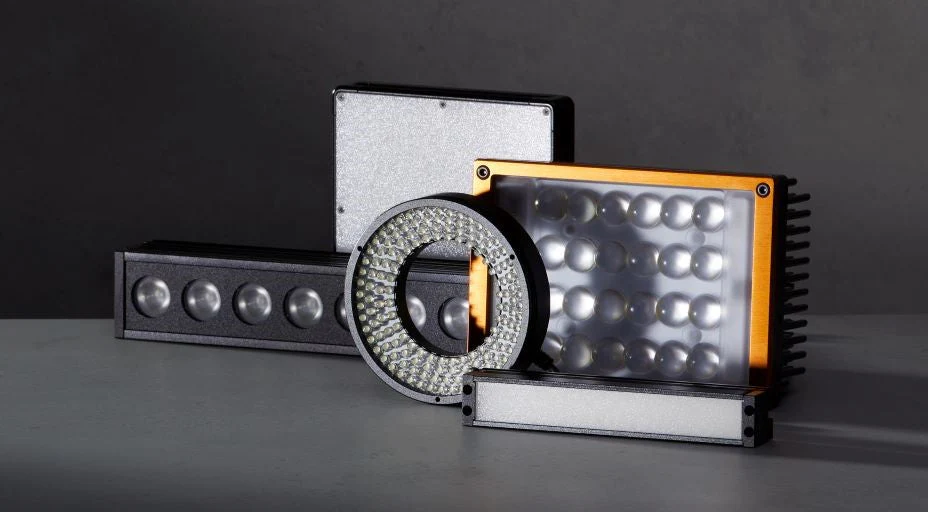
Vision lighting comes in several geometries, each suited to a different problem. Ring lights mount around the camera lens and produce uniform front illumination, which works well for general inspection. Bar lights are positioned off-axis to create shadow and reveal surface texture or relief. Dome lights produce shadow-free diffuse light that wraps around curved or reflective parts. Backlights sit behind the object to silhouette it for precise edge measurement. Coaxial lights direct light along the same optical path as the camera, which works well on flat, shiny surfaces like silicon wafers or polished metal.
Wavelength matters as much as geometry. Red light reveals contrast on certain printed labels. Blue light highlights surface scratches. Infrared and near-infrared can penetrate translucent materials. Ultraviolet excites fluorescent markers. Engineers pick the right combination by treating light as a tunable variable, not an environmental constant.
Where it shows up on the factory floor
The applications are wider than most people assume. Visible examples include:
- Agricultural sorting lines, where colour-sensitive cameras grade coffee beans, cocoa pods, or maize and reject damaged or unripe units.
- Beverage and bottling plants, where vision systems check fill levels, cap placement, and label alignment thousands of times per hour.
- Pharmaceutical packaging, where barcodes, expiry dates, and tamper seals are read at high speed for compliance.
- Plastics recycling, where short-wave infrared light lets sorters distinguish polymer types that look identical to the human eye.
- Automotive parts manufacturing, where bar lights expose welding flaws and dome lights inspect the geometry of moulded components.
- Electronics assembly, where coaxial illumination reads engravings and verifies solder joints on circuit boards.
Across these settings, the camera and the algorithm are largely interchangeable. The light source is what makes the defect visible in the first place. Swap a fixed white LED for a properly chosen wavelength, and the same camera and the same model can move from unreliable to industrial-grade detection overnight.
Why the topic matters right now
Two pressures are pulling more manufacturers toward automated vision. The first is the cost of human inspection. Skilled inspectors are expensive to train and slow compared with a camera running at line speed. The second is buyer expectations. Export-bound food, pharmaceutical, and packaged goods now face stricter quality audits, along with traceability requirements that demand recorded inspection data per unit.
For African manufacturers, the opportunity is sharper than in already-saturated markets. Lines being designed today can install vision at the same time as the conveyor and the control system, rather than retrofitting it later. Capital is leveraged once. Energy use also lands in the brief. LED-based vision lighting typically draws only a few watts per fixture and pairs cleanly with solar-backed factory power, which matters in regions where grid stability cannot be assumed. The decisive cost in a vision installation is rarely the camera, which has dropped in price for a decade. It is the engineering time spent fighting unreliable lighting. Picking the correct fixture at the start removes weeks of trial and error and a great deal of subsequent maintenance.
How to choose the right fixture
Three questions decide the right fixture for any inspection task.
- What feature needs to be visible? Surface defects need raking angles. Edge measurement needs backlighting. Colour-coded parts need a wavelength that maximises contrast against the background.
- What is the working environment? Lines exposed to dust, washdown, or vibration need sealed housings, typically IP54 or higher. Outdoor staging needs covers that block ambient infrared.
- What level of control is required? Strobed lighting synchronised to the camera trigger reduces blur and extends LED life. Adjustable intensity helps when materials or operators change between batches.
Working through those questions in order, before specifying the camera, almost always produces a more reliable system than picking the camera first and lighting the scene afterwards.
The bigger picture
Machine vision is becoming routine equipment in any factory that wants to keep pace with international quality benchmarks. The cameras and the AI models will keep improving on their own timeline. The lighting, by contrast, is a deliberate engineering choice made once per line. Treating it as a strategic decision rather than a finishing touch is the cheapest way to make every other component in the vision stack perform better. The smart factories that emerge over the next decade will not be defined by which cameras they bought. They will be defined by what they made the cameras see.