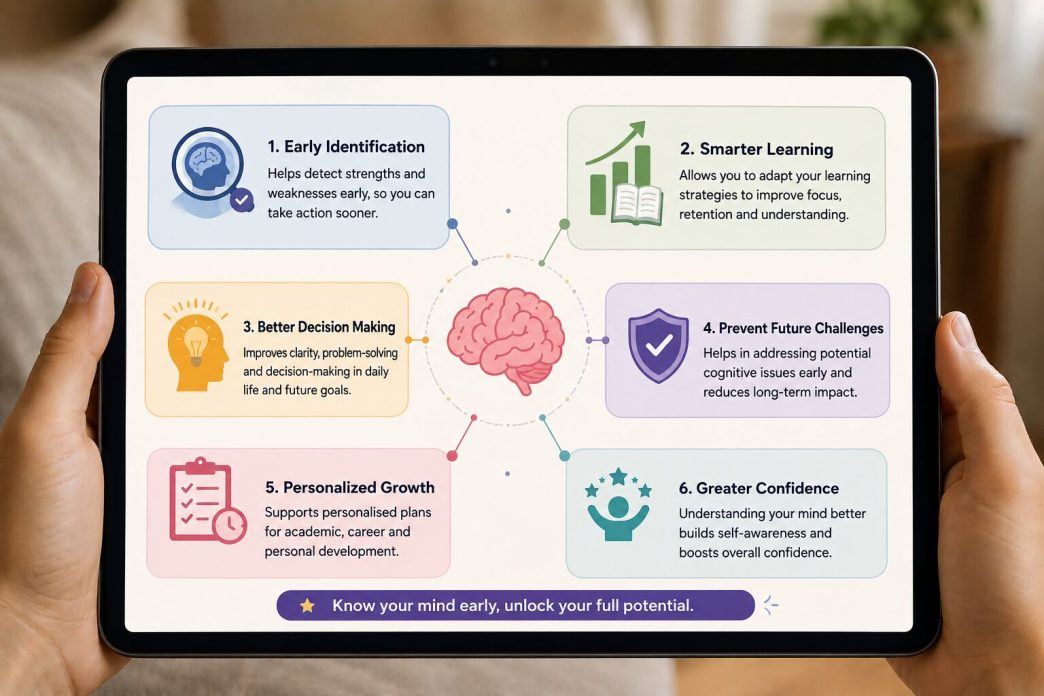
A common saying in our culture is to describe someone as being “good with numbers” or “more of a people person.” While these statements attempt to describe an individual’s ways of thinking and approaching life, there are far more complex factors to consider when trying to understand an individual. Realizing how you think and learn to approach problems in life can be one of the greatest tools that you can develop during your academic and professional life.
Early identification of individual’s strengths and weaknesses in terms of their cognitive performance creates a roadmap for his/her academic and professional growth and development.
Building authentic self-awareness
Most people don’t have any idea how they actually think until they are tested with a cognitive assessment. You may have average to poor working memory, but have the ability to recognize patterns very well. Alternatively, you may have very good verbal reasoning abilities, but process information slowly.
While knowing your general strengths and weaknesses can be a good starting point for determining possible career choices, it is not enough. This type of general knowledge is not very accurate and does not give a good enough idea of a person’s true abilities. For example, many people say that they are “not a math person,” without realizing that the reason for this is because they have not yet been properly taught how to use numbers to their full potential. Others consider themselves to be “more of a people person,” not realizing that their verbal skills can be used in a wide variety of quantitative fields.
Knowing how your brain works in the early stages of your academic life is very beneficial. It can actually help you make right academic choices. For example, a student with very good spatial ability can opt for Engineering or Architecture in his undergraduate studies. On the other hand, a student with very good verbal ability can go for studies like Literature or even Law in his undergraduate studies.
Optimizing academic performance
Study methods that actually work
The way a student studies for a test will depend greatly on their spatial and visual processing abilities. For example, a student with strong spatial and visual processing abilities may use many diagrams, charts, and flowcharts when studying. A student with strong auditory processing abilities, on the other hand, would benefit from recorded lectures and a discussion group. Generic study advice often neglects the individual differences that exist in the way people process information.
Generic study techniques are not as effective as an individual’s alternate studying methods which focus on better utilizing that individual’s talents and strengths. For example, an individual of high visual ability could make use of studies of long duration by creating diagrams and pictures that can be used in order to make studying of complex information more understandable by using visual aids. This could enable the individual of high visual ability to study for as long as is required in order to reach their full potential.
Managing limitations before they become problems
Each person has a particular set of cognitive strengths and limitations. The particular weaknesses of a person are offset by the particular strengths of that person. Therefore, it is very important to develop strategies as early as possible to compensate for the limitations of a person in order to help that person reach his or her full potential. This is possible by first understanding a person’s cognitive profile through online IQ assessment and other tests.
Speed: If you have slow or average processing speed, this may affect how quickly you can read, complete written work, or complete tests and exams. You may need to have extended time to complete tests and/or to complete written work. You may also use external organizational tools to help you keep on top of your school work. This could be a calendar, to do list, set of reminders on your phone etc. An online IQ assessment can help to determine how your processing speed affects your way of learning, and how you can work to your full potential in situations where your processing speed may be a limitation.
Students also don’t know that these accommodations exist, nor are they qualified for them.
Career decisions based on reality
The correlation between a job and an individual’s natural cognitive functioning and their career satisfaction is very strong. Most people enter into a career because of an interest that they have in something, but it can be very valuable for people to discover whether or not they would be good in a quantitative type of verbal career of function. Many people have the ability to function very well in a career of reason, or being able to come up with solutions to problems using their reasoning skills. Some people have processing speeds that are very slow, so they may not be as good in careers that require rapid processing. Other people have large working memories and are able to multitask and switch between tasks quickly. Careers that require holding a lot of information in working memory would be a good fit for these people.
This information is also good for people who are returning to school or who are trying to figure out what career path is best for them. Two students recently came to me for advice. Both of them were interested in the health care field. However, after looking at their strengths and weaknesses, I told the first student that he would be a great fit for emergency medicine. I also told him that he would also be good at other careers that required similar reasoning skills and processing ability to process information. The second student would not be as good of a fit for this type of career. However, after looking at his strengths and weaknesses, I was able to tell him of a few different careers in the health care field that would be a good fit for him.
Finally, by taking an online IQ test, you can determine the best way to spend your money to get the greatest return on your investment. If you have higher than average processing speed then a career in fast-paced environments may be very lucrative. If you have robust working memory then you may do well in careers that require you to handle multiple tasks or projects at any given time. And, if you have exceptional verbal reasoning abilities then you may be very successful in quantitative fields such as law, writing, or public speaking.
Avoiding costly mistakes
Some adults don’t find out the true makeup of their cognition until they are well into their adult years, in some cases having struggled their whole academic life because they were in the wrong quantitative-oriented program when they are actually a verbal-oriented individual. The same holds for professionals who have gone into the wrong career because of miscalculating their potential, or those who have avoided taking on challenges that they could actually do well because they have an inaccurate estimation of their capacity.
Many people go through the quantitative-based studies in search of better life, because they did not know that their quantitative abilities were only average and that their verbal-based reasoning abilities were above average; or that because of how they processed information, they were not able to perform as well as others on certain kinds of tasks. On the flip side, some individuals could be avoiding very challenging and potentially extremely rewarding academic, or business, or career opportunities because of an underestimate of their true abilities.
An early test of your IQ can save you from making grave mistakes in your studies as well as in your career. It will give you valuable information about your strengths and weaknesses, thus allowing you to choose the right course of study, and later on the right career path that will help you to fully develop your potential, grow and reach your full peak.
IQ tests help to identify the cognitive strengths and weaknesses of an individual, which can be used to enhance self-awareness of one’s potential. A number of individuals greatly underestimate or overestimate their cognitive ability and IQ test results can provide the much needed feedback on their learning potential. Once an individual has identified the cognitive strengths and limitations of their mind, they can engage in activities that will challenge them to reach their full potential.
Knowing how you work early on can be a powerful tool for guiding future learning and career decisions. By having a better understanding of how you work, you can go on to build a life that best fits your mind.