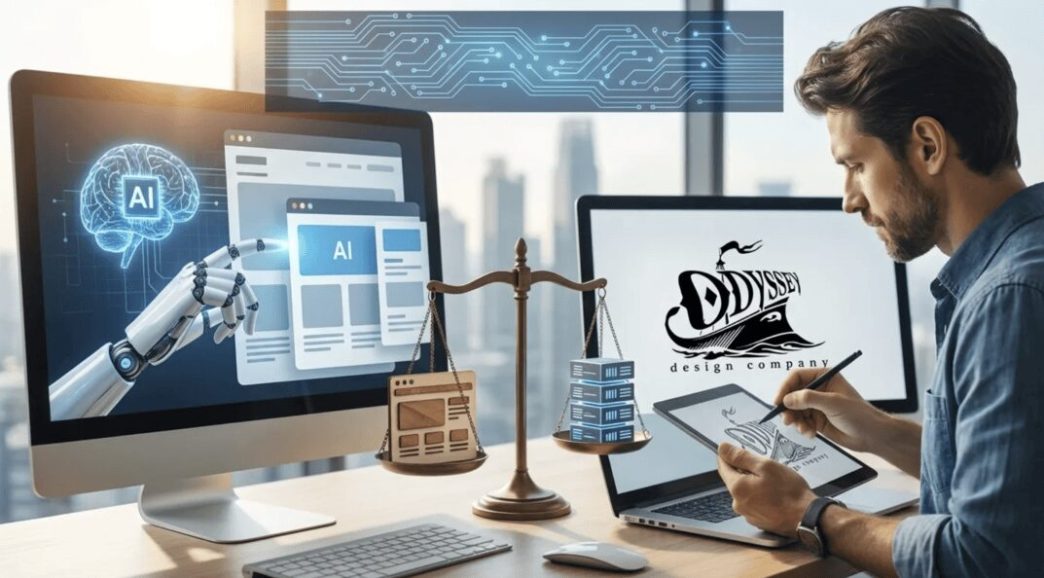
The Disruption Is Already Here
Not long ago, building a website required real technical skill. Clients depended on expert web designers who understood code, layout, hosting, and user behavior. That expertise came with a price tag and clients paid it because there was no other option.
Then the wave arrived.
Platforms like Wix, Squarespace, and Webflow put website creation in the hands of everyday business owners. WordPress made it plug-and-play. And now AI-powered tools like Durable, Framer AI, and Wix ADI can generate a complete, content-filled, mobile-responsive website from a single text prompt — in under a minute.
For freelance designers, this raises an uncomfortable but urgent question: if anyone can build a website, why would anyone pay you to build one?
The honest answer is more complicated — and more hopeful — than the panic headlines suggest.
What No-Code and AI Tools Actually Do Well
To understand the threat, you have to understand the capability.
Speed and Affordability
A small business that might have paid a freelancer $3,000–$6,000 for a basic website can now get something functional for $20–$50 a month on a subscription platform. For a local restaurant, a solo service provider, or an early-stage startup just trying to exist online, the economics are hard to argue with.
Expanding Capabilities
Modern no-code tools have moved well beyond simple templates. Webflow offers full CMS functionality and advanced animations. Shopify handles complex ecommerce without a developer. Framer lets designers publish interactive, production-ready sites directly from what used to be static mockups.
AI adds another layer entirely. Tools like Adobe Firefly generate on-brand imagery, Figma AI drafts layouts mid-session, and code generators like v0 by Vercel produce deployable frontend components from plain-English descriptions. The tasks that freelancers once billed hours for are collapsing in time and cost.
The Segments Most Affected
The clients most likely to self-serve are local businesses needing a basic online presence, startups testing ideas in MVP phase, content creators launching personal brands, and nonprofits on tight budgets. These were all genuine sources of freelance work, and their shift toward self-serve platforms is real.
Where the Tools Fall Flat
Here is what the disruption narrative consistently gets wrong: it confuses a website that functions with a website that performs.
The Generic Output Problem
AI tools are trained on existing design patterns. They excel at producing what is statistically average. They struggle profoundly with brand differentiation — creating a visual identity that actually stands out — and with strategic UX thinking, which means designing a site not just to look good, but to guide users toward a specific action.
The result? AI-generated websites look like AI-generated websites. Same color logic, same layout structure, same hero section formula. For businesses serious about their brand, this sameness is not just aesthetically disappointing — it actively damages their competitive positioning.
Strategy Cannot Be Prompted Away
A skilled freelance designer does not just assemble pages. They ask the questions clients don’t even know they need answered: Who is the primary user, and what are they trying to accomplish? What is the one conversion action that matters most? How does every design decision serve that action?
This is strategic consulting work. It requires business understanding, empathy, and contextual intelligence that no AI currently possesses. Clients who understand the difference between a website as a digital brochure and a website as a revenue-generating asset will always value a human who thinks strategically on their behalf.
Complex Projects Are Growing
The democratization of basic website creation has not eliminated complexity — it has redistributed it. While simple informational sites migrate toward automation, the complex end of the market is expanding:
- Enterprise web applications with custom authentication and data architecture
- High-performance ecommerce with custom checkout flows and integrations
- Membership platforms with gated content and subscription management
- Accessibility-critical projects for healthcare, education, and government
- Custom interactive experiences that drive brand differentiation
No AI generator produces any of this reliably. These projects require skill, judgment, and experience — and they pay substantially better than the commodity work being automated away.
How Smart Designers Are Adapting
The freelance designers who will thrive are not the ones fighting the tools. They are the ones who have figured out how to use them — and how to position their work above the level where automation competes.
From Builder to Strategist
The title “website designer” is increasingly insufficient for sustainable freelance positioning. Designers who are winning right now have reframed their value proposition around outcomes, not outputs. They are not selling a five-page website — they are selling a 40% increase in leads, a stronger brand impression, a higher-converting checkout flow.
When you compete on business outcomes rather than deliverables, AI generators are not your competition. They are your production tools.
AI as a Force Multiplier
Designers who have integrated AI into their workflows report dramatic productivity gains — generating multiple layout concepts in the time it once took to produce one, drafting client-ready copy in hours rather than days, and automating repetitive QA tasks entirely.
A skilled freelance designer using AI effectively can serve more clients, at higher quality, with faster turnaround — while charging more for the strategic layer they bring. This is not a defensive posture. It is a genuine competitive advantage over both AI-only tools (which lack strategy) and designers who refuse to adopt AI (who lack speed).
Specialization as the Most Durable Defense
The most sustainable freelance position today is deep vertical specialization. Consider the difference between a generalist designer who builds websites for anyone who hires them, and a designer who exclusively serves independent financial advisors and deeply understands compliance requirements, client trust psychology, and conversion patterns specific to wealth management.
The second designer faces almost no competition from AI generators. Their clients are not price-shopping — they are expertise-shopping.
Powerful vertical niches include healthcare practices, legal firms, real estate professionals, e-learning creators, and luxury service brands — all of which involve nuance, compliance, and audience psychology that generic tools simply cannot address.
The Three-Tier Market Reality
The web design market has restructured into three distinct tiers.
Tier 1: The Commodity Market (Under $1,500)
AI and no-code have claimed this territory. Simple informational sites with template-driven design. Competing here in 2025 is untenable for most freelancers. The strategic move is to exit this tier deliberately — refer those clients to self-serve platforms and free yourself to work at a higher level.
Tier 2: The Professional Market ($2,000–$15,000)
This is where the real freelance opportunity lives. Custom-designed sites with strategic intent, brand integration, and performance optimization. AI tools can produce outputs that look like they belong here — but they consistently fall short on true differentiation and strategic architecture. Designers who lead with strategy and deliver measurably better outcomes have a clear and defensible position.
Tier 3: The Complex and Enterprise Market ($15,000+)
Largely untouched by consumer AI disruption. Large-scale applications, multi-site corporate architectures, and custom platforms require expert judgment that no automation replaces. Senior freelancers who specialize at this level compete on depth — something agencies cannot match on cost, and in-house teams cannot match in expertise.
What the Next Few Years Look Like
AI capabilities will continue improving. Text-to-website tools will get better at brand differentiation. More commodity work will be absorbed by self-serve platforms. That trajectory is not reversing.
But several forces will sustain demand for skilled human designers at the same time:
Regulatory complexity is growing. Web accessibility requirements and data privacy standards are expanding and increasingly legally enforced. Navigating compliance demands expertise that templates cannot provide.
Brand differentiation will become more valuable. As AI-generated sameness proliferates, businesses serious about standing out will invest more in distinctive, strategy-driven design — not less.
User expectations keep rising. As people experience excellent digital design more frequently, tolerance for mediocre AI output decreases continuously.
The designers most at risk are generalists competing on price, order-takers who execute without adding strategic thinking, and those who resist AI adoption. The designers who will thrive are specialists, strategists, and those who treat AI fluency as a core professional skill.
The Real Answer
Freelance website designers will not all survive. Those who built their practice on executing templates and competing on price were always in a vulnerable position — AI has simply made that vulnerability impossible to ignore any longer.
But the designers who adapt will not merely survive. Those who reposition around strategy, specialize in high-value niches, adopt AI as a production tool, and compete on outcomes rather than outputs will find a less crowded market with better clients, higher margins, and more meaningful work.