If you’ve ever launched an app, you know the feeling.
You upload it. You wait. You refresh the dashboard. You hope.
Days go by. Downloads trickle in. You have no idea if you’re doing well, doing badly, or just existing in the massive sea of apps that nobody can see.
The app stores don’t help. They show you your own numbers downloads, maybe revenue but nothing about what’s actually happening around you. Are your competitors growing faster? Is a new category emerging that you should jump into? Did someone just launch something that makes your app obsolete?
You’re flying blind.
The Problem with Building Apps in 2026
The app market isn’t what it was ten years ago. Back then, you could build something decent, put it in the store, and people would find it. The stores were hungry for content. Discovery was easier.
Now? There are millions of apps. The stores are crowded. Discovery is broken. Most apps never get found.
The ones that succeed don’t just build good products. They understand the market. They know what’s working, what’s trending, where the gaps are. They watch their competitors like hawks. They move fast when something changes.
Without that visibility, you’re guessing. And guessing in a market this crowded is a fast way to fail.
What You Actually Need to Know
If you’re running an app whether it’s a game, a productivity tool, a fitness app, or anything else there are specific things you need to track:
Where do you rank? Not just overall, but in your category. Movement up or down tells you something about your visibility, your momentum, your place in the market.
What are competitors doing? Did they just update their app? Add a feature? Change their pricing? Run a promotion? These moves affect you, whether you know about them or not.
What’s trending? New categories emerge. Old ones fade. Sub-genres explode overnight. If you’re not watching the trends, you’ll miss the next wave.
What are users saying? Not just about your app, but about competitors. Reviews are a goldmine of information about what users want, what they hate, what’s missing.
Where are the gaps? Is there a subcategory with high demand but low supply? A feature that everyone’s requesting but no one’s building? An audience that’s being ignored?
This isn’t nice-to-have information. It’s the difference between growing and stagnating.
What Changes When You Can See the Market
An app analytics tool that shows you the whole market changes how you work.
Instead of guessing, you know. Instead of reacting, you can plan. Instead of hoping, you can execute.
For solo developers and small teams, this is especially powerful. You don’t have a market research department. You don’t have a competitor intelligence team. You have you. A tool that shows you what’s happening lets you compete with teams ten times your size.
For marketing leads, it means you can see what’s working for others and adapt it. That campaign that drove downloads for a competitor? You can see it happen in real time. That feature that got users excited? You can read the reviews and understand why.
For game developers, it means you can track the categories that matter to you. Casual games. Hypercasual. RPGs. Puzzle. Whatever your niche, you can see the movers and shakers.
The Specific Things a Good Tool Shows You
Let’s get concrete about what this looks like in practice.
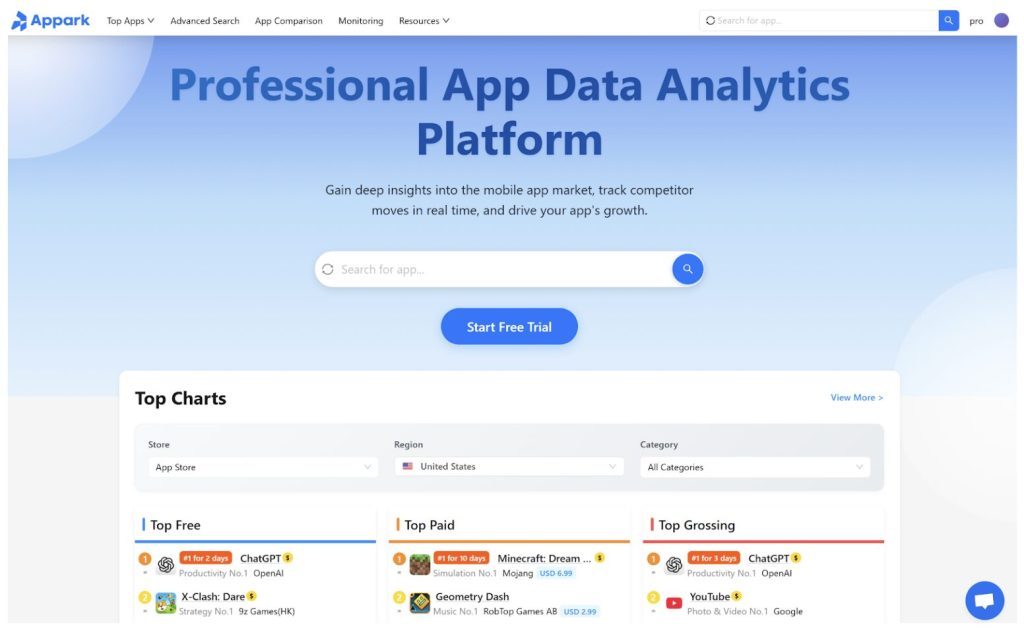
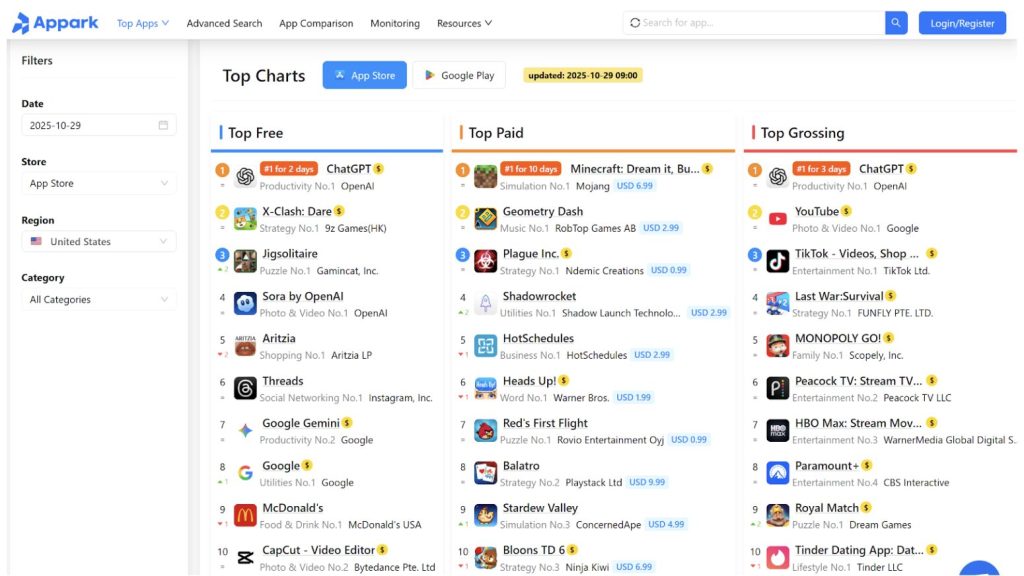
App store rankings updated in real time. Not yesterday’s data, not last week’s, but now. You can see when an app jumps 20 spots and ask why. You can see when you drop and investigate.
Category breakdowns. Not just overall charts, but specific categories. Productivity. Photo and video. Health and fitness. Games of every type. You can drill into your exact niche.
Competitor monitoring. You pick the apps you care about up to 50 of them. The tool watches them for you. When they update, when they change features, when their ranking shifts, when their ratings change, you know.
Historical data. Not just what’s happening now, but what happened before. You can see trends over time. You can spot patterns. You can learn from the past.
Similar app discovery. Find apps you didn’t know existed that compete in your space or adjacent spaces. Find new threats and new opportunities.
Review analysis. See what users are saying about competitors. Find the features they’re begging for. Find the problems they’re complaining about. Build a better product.
Who Actually Uses This Kind of Data
The people who get the most out of app analytics cut across the whole industry.
Indie developers use it to find gaps in the market. One developer quoted in the product materials talked about spending three hours a day manually digging through app store data before finding a tool that automated it. Now he spots opportunities he would have missed.
Game studios use it to track competitors and spot trends. A mobile game team noticed a competitor’s update that improved retention. They adapted the idea, ran their own update, and saw daily players jump 28%.
Marketing teams use it to time their campaigns. When a competitor runs a challenge or a promotion, they see the impact in rankings. They adjust their own timing and messaging accordingly.
Product managers use it to prioritize features. When user reviews across multiple competitors all ask for the same thing, you know what to build next.
Investors use it to find promising apps and categories before they blow up.
The Gap Most Tools Miss
Here’s what’s hard to find in most app analytics tools: the ability to discover new categories and niches before they’re obvious.
The big charts show you what’s already popular. That’s useful, but it’s also late. By the time an app is in the top 10, everyone already knows about it.
The real opportunity is in the subcategories, the emerging niches, the apps that are growing fast but haven’t hit the mainstream yet.
A tool with good app store rankings and filtering lets you find these. You can filter by category, by growth rate, by new entries. You can spot the apps that are moving up before everyone else notices.
What You Can Actually Do With This
Once you have visibility into the market, the possibilities multiply.
Find your next feature. Look at what users are asking for in competitor reviews. Build it.
Time your updates. Don’t launch a major update the same week a competitor launches theirs. Watch their timing and plan around it.
Spot emerging threats. That new app in your category that’s growing fast? You see it early and can respond.
Discover new categories. That sub-genre you never considered? It’s growing 30% month over month. You get in early.
Validate your ideas. Before you build something, check if similar apps exist and how they’re performing. Save yourself from building something nobody wants.
Understand your users. Read reviews across the category. Know what people actually want.
No More Flying Blind
Building an app without market data is like driving with your eyes closed. You might move forward, but you have no idea where you’re going or what’s coming.
A good analytics tool opens your eyes. It shows you the map, the traffic, the obstacles, the shortcuts. It lets you make decisions based on reality instead of hope.
For solo developers, for small teams, for anyone trying to grow an app in a crowded market, that visibility changes everything.
You stop guessing. You start knowing.