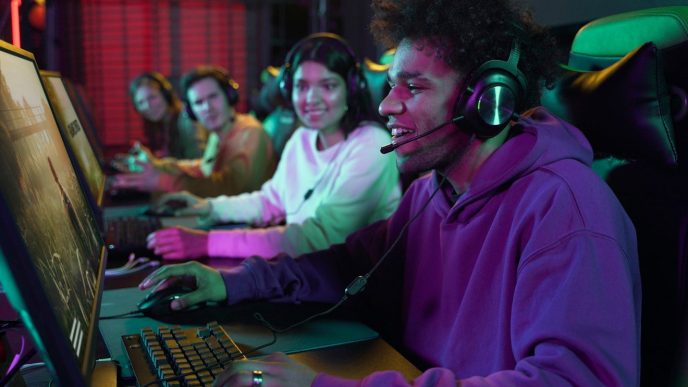
When a player launches a game and everything from menus to dialogue lines to buttons feels instantly familiar, something clicks. There’s no hesitation. Just a seamless experience that lets the player dive straight into the action. A skilled game localization agency ensures that every element speaks naturally to players across different languages and cultures. The player can focus on the game instead of decoding the language. Games are now able to reach out to millions across the globe within days after their release. For example, a game released in the US can reach out to millions in Brazil, Korea, Germany, or Indonesia. Digital stores have managed to remove geographical barriers. It allows games to reach players across the world.
Research across the gaming industry shows a clear trend: when players struggle with menus or unnatural dialogue, engagement drops. Most players won’t complain; they simply move on to another game.
The opposite happens when the interface feels resonant to a player’s language and culture. Curiosity turns into immersion. Players explore menus more freely and spend more time in the game world. For studios targeting global growth, that difference is huge. It impacts retention and the long-term strength of the player community.
Why American Game Studios Think Globally Early On
The United States remains a hub for game development. From major publishers to indie studios, American developers operate in a market where global reach is the default expectation. Releasing a game only in English no longer makes sense.
Many studios now plan localization during early development rather than after launch. Tutorials, menus, and dialogues are structured so they can adapt to multiple languages without breaking gameplay.
Engagement depends on comprehension. Players who struggle to understand interfaces rarely explore advanced game systems. Complex crafting menus, skill trees, and multiplayer tools become frustrating barriers instead of exciting features.
Specialized gaming translation services assist game developers in avoiding these problems even before they are released in foreign countries. Their translations modify words in such a way that instructions and menus appear clear and easy to navigate regardless of the country they are in. Clear interfaces have an impact on how long players will play a game.
How Small Details Influence Behavior
Game interfaces may look simple, but every button, label, and menu guides player behavior. Players constantly interact with menus, skill descriptions, inventories, and multiplayer lobbies. Each step depends on understanding short pieces of text.
Poor translations cause immediate friction. Players might leave before they even explore the deeper systems.
Some interface elements tend to impact engagement the most:
- Navigation buttons and control instructions
- Tutorial messages explaining core mechanics
- Notifications and alerts
- Inventory and crafting descriptions
- Multiplayer settings and matchmaking prompts
All these form the language of the game. When players can navigate smoothly, they explore, experiment, and stick around longer.
Cultural Nuance Shapes Understanding
Language is not only about words. Culture influences how players will perceive words. Phrases that sound appropriate in English might sound too direct or clumsy in another language. Humor and slang can become unintelligible if translated literally.
Localization experts might change these instead of directly translating them. The goal is authenticity. Players sense it quickly. That sense of familiarity can boost immersion even more than impressive graphics or mechanics.
Behind the Scenes: Software Translation Service
Beyond gameplay text, an often-overlooked layer shapes the player experience: software systems. Game interfaces include error messages, account prompts, and update notes. These rarely get marketing attention but affect how players interact with the game.
A professional software localization service can handle this critical layer. They ensure that every login message, system alert, or update notification is clear and fits the interface correctly. Technical details matter. Some languages require more space compared to English, potentially breaking buttons or menus if handled poorly. Smooth interfaces rely on that precision.
Players Engage When They Feel Included
The global gaming audience is incredibly diverse. Mobile titles reach remote regions. Competitive games unite players from continents apart. Social games connect players who share few linguistic similarities. Language becomes the bridge. When interfaces feel natural in a player’s language, players feel included. That sense of belonging builds loyalty. Players reward games that respect their language and culture. Reviews improve. Communities form faster. Word-of-mouth spreads locally. This comfort influences how long players stay and how engaged they are. Engagement Ripples Into Communities. A well-localized interface allows players to focus on the social aspects of a game. Players can discuss strategies instead of asking about menus or mechanics. Competitive games benefit even more. When international players understand the systems clearly, esports scenes develop naturally.
Business Impact of Multilingual Interfaces
For studios, multilingual interfaces influence measurable outcomes. Player retention improves after proper localization. Titles initially released in one language often see noticeable growth when additional languages are added.
Revenue patterns shift too. Players who understand store menus and item descriptions feel confident making purchases. In free-to-play models, that confidence matters. Studies in American game studios often show that localized regions enjoy stronger engagement compared to regions without proper language support. Simply put, understanding keeps players around longer.
Early Localization Reduces Headaches Later
Old-school development pipelines treated localization as a final step. Games were translated after almost everything else was finished. That approach caused problems. Text expansion could break layouts. Tutorials sometimes needed rewriting. These mechanics became confusing.
Today, studios plan localization from the start. The interfaces are designed with flexibility in mind. The system is designed to allow multiple languages without significant redesign. Localization teams work closely with developers, UI designers, and narrative teams. Early involvement helps avoid costly fixes and enhance the player experience.
Conclusion
The multilingual interfaces are shifting towards dynamic linguistic personalization. AI can currently assist with dynamic dialogues and live adjustments. Nevertheless, human expertise is always required. Language contains nuance, humor, and context that AI can never completely comprehend. As gaming continues to spread and penetrate further into new areas, multilingual interfaces will become even more significant. Understanding drives engagement. When a game speaks naturally to players, curiosity transforms into long-term loyalty. And that loyalty is exactly what studios hope to achieve.