If you’ve spent any time on Forest Service roads in summer, you already know what a flash thunderstorm does to clay. A road that was a perfectly drivable two-track at 11 AM becomes a six-inch-deep rut with greasy red walls by 2 PM. You’re alone, your boat is in the water somewhere or your tree stand is half a mile in, and the cell signal that worked at the trailhead doesn’t work where you parked.
This is the most common stuck scenario for bowhunters scouting late-summer trails, fly fishermen accessing alpine streams, and wildlife photographers driving to dawn shoots in remote BLM land. It’s also the scenario most outdoor industry recovery articles ignore, because they assume you’re traveling with a buddy vehicle.
Most outdoor truck owners carry one of two recovery setups: a winch with a 50-foot strap, or a 30-foot tow strap and the hope of a passing truck. Both have problems specific to backcountry use.
A winch needs an anchor point. If you’re stuck in the middle of a clay ridge, with no large trees within 50 feet of the front bumper, your $1,200 winch is a paperweight. Trees count, but only big trees. Your winch will pull a 6-inch sapling out of the ground before it pulls your truck out of mud.
A tow strap needs a second vehicle. On a Forest Service road two miles past the last trailhead in October scouting season, a second vehicle isn’t passing by. You can stand there until you hear one, or you can solve the problem yourself.
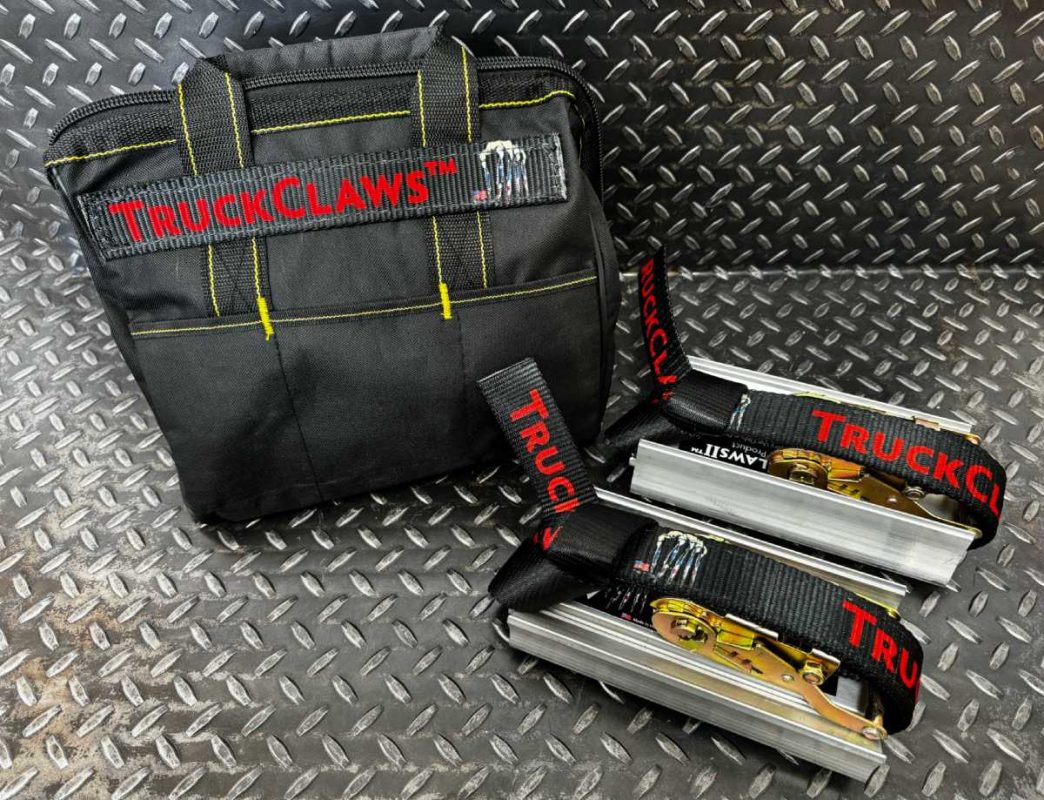
Solo recovery — the kind that doesn’t require an anchor point or a second vehicle — is its own category, and the tools that work in it are specific. A tire-mounted traction aid is the most useful single tool for the solo-stuck scenario because it works regardless of what’s around you. No tree, no buddy, no problem. The TruckClaws Light Truck Kit is built for half-ton, three-quarter-ton, and one-ton pickups under 30,000 lbs GVW — which covers basically every outdoor truck on the road.
The install on a hunt-truck takes about 90 seconds per wheel:
Park, set the brake, get out with the kit in hand.
Identify the drive wheel that has the most weight on it (usually rear-uphill on a 4WD).
Wrap the strap around the tire so the steel cleat sits across the top of the tread.
Crank the ratchet down hard.
Get back in, low gear, gentle throttle. The cleat bites, the tire rotates one full revolution, and the truck lifts forward six to eight inches.
Repeat one or two more rotations and you’re back on the unstuck part of the road.
A practical $250 backcountry recovery kit for a hunting or fishing truck:
TruckClaws Light Truck Kit (~$149)
Folding entrenching tool (~$25)
12V tire inflator that runs off the cigarette lighter (~$60)
A 20-foot recovery strap as a backup for buddy-vehicle scenarios (~$30)
Heavy work gloves (~$15)
Total weight: under 20 lbs. Total volume: fits in a milk crate behind the seat. Total cost: less than what AAA charges for a single rural towing call after they tell you they can’t reach you anyway.
A few habits that keep solo backcountry trips solo and not stuck:
Tell someone where you’re going AND when you’ll be back. Not “the mountains.” Print the FS road number and the latitude/longitude of where you parked.
Watch the sky in the afternoon. If you see thunderheads building west of you, you have about 90 minutes before that road becomes a recovery exercise. Get out before then or commit to spending the night.
Drive with one eye on the surface. The road that drove fine on the way in may not drive the same way on the way out — clay roads dry harder and rut deeper as a storm passes through.
Don’t park in the bottom of a draw. Water flows downhill. Your truck is the one in the lowest spot.
Check tire pressure before you leave the trailhead. 25 PSI on a backcountry road handles surface variation better than 35.
The tool that pulls a hunter’s pickup out of a clay rut at sunset is the same tool that pulls a fly fisherman’s truck out of a creek bottom at noon and the same tool that gets a wildlife photographer’s rig back to the trailhead before nightfall. It doesn’t care what the trip was for. It cares whether the wheel can rotate.
When you’re alone, that’s the only thing that matters.