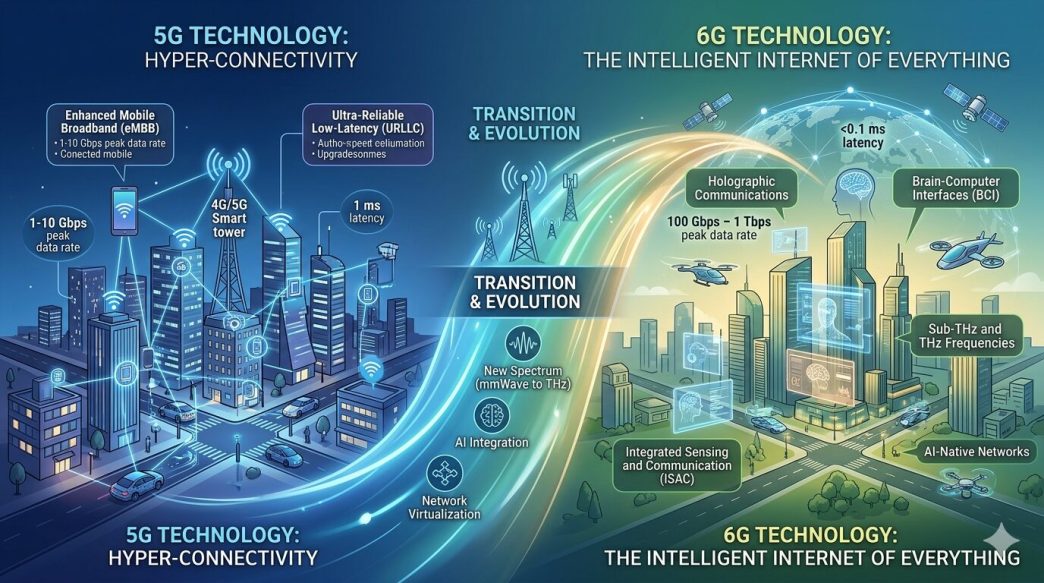
The Australians are not new to fast-changing technology. We are living the connected world, starting with the introduction of the National Broadband Network and almost everywhere 5G. However, even though 5G is yet to establish itself in the regions, the world is already looking at the horizon. 6G is on its way. It is believed to be commercialized by 2030, yet the foundation should be drawn today by the experts in iOS mobile app development.
1. Near-Zero Latency plan: Instant is the New Norm
Raw speed will not be the most dramatic change in 6G, but elimination of lag. We are shifting towards real-time to instant interactive.
Haptic and Tactile Internet:
Existing networks are capable of transmitting high-definition video, however, 6G will make the Internet of Senses possible. It is the first time that complex, low-latency applications that demand the ability to provide fine tactile feedback, including remote surgery, complex drone piloting, or an immersive virtual collaboration, will be made a real possibility on mobile devices.
Gaming and High-Frequency Trading:
Milliseconds count in a competitive game. 6G will eliminate the difference in playing local and online. Finance applications that are designed to analyse and perform market operations in a fast way will run on faster speed that is limited to desktop computers tied to specific fibre lines.
2. Get Ready to Massively Distributed Compute: be the Edge
At its very base, 6G is built in such a way that it supports Artificial Intelligence (AI) and machine learning anywhere. The archaic method of transmitting information to a central cloud server, which can be processed and transmitted back will be rendered irrelevant to the latency sensitive tasks.
AI Inference on the Edge:
Edge Computing will be a major part of 6G infrastructure. Your apps have to be created to handle computational loads (such as real-time video analytics or generative AI) on the user device itself or in a cellular tower within a few meters.
Network Slicing:
Sophisticated Network Slicing will be possible in 6G. It implies that your application can invoke the dynamic request of the respective network properties it requires. A telehealth application may demand an ultra-reliable, high-priority slice to support a video conference, and a social media background upload may use a standard, high-bandwidth slice. The developers will be expected to understand how to communicate with these network APIs.
3. Rethinking the Interface: What Comes after the Flat Screen
With 5G that allows smoother streaming, 6G will make it possible to have volumetric streaming. The next version of the social feed that will be considered the killer app of the 6G era will be immersive and spatial.
The incorporation of AR and VR in the learning process should include proximal reality (the integration of computer games with real-life experiences) and extended reality (the integration of computer games with human perceptions).
Over the years, we have been talking about Augmented Reality (AR) and Virtual Reality (VR). 6G offers the infrastructure of Extended Reality, a smooth combination of the two. Applications will enable common, high fidelity holographic environments. This requires that the UX (User Experience) design change in 2D interfaces (screens) into 3D interfaces (spaces).
Post-App Store Discovery:
The Progressive Web Apps (PWAs) that can be supported by 6G will be indistinguishable to native apps. With a complex, heavy experience streamable with zero lag in a browser, the classic download model in the app stores can fade away. Your plan should involve instant-access applications.
4. Resolving Ubiquitous Connectivity: Terahertz and Integration
The 6G is not merely high speed in the city, it is full global access, incorporating traditional land networks with high-throughput satellite groups.
Non-Terrestrial Networks: Within the building, non-terrestrial networks are implemented to connect every building level, including the ground floor, mezzanine, and third floor, at a single site.
Australians are familiar with the issue of regional and rural connectivity. 6G will support satellite access. In the case of app developers, this will require them to develop resilience into apps so that they operate perfectly in remote areas without users being forced to change the settings on their own.
Baudrillard, Architectural Paradox:
More advanced on-device antenna design will be necessary using higher frequency bands (Terahertz spectrum). Moreover, a hyper-connected 6G world creates new vectors of security. The architecture should not be based on the addition of trust and security features.
Summary
The introduction of 6G will re-define the way of mobile app development. Although the commercial use of 6G is years off, this future landscape will dictate the architectural choices developers can and should make today on how they use clouds, what security protocols to consider, and what spatial interfaces to implement. The fundamental needs do not change: either in the case with iOS Mobile App Development or in the wider context of the cross-platform market, the demands of the users regarding the speed and integration will only grow.