Sometimes, in the fast-paced world, it’s challenging to notice how quickly our lives are evolving. This is noticeable in some industries we interact with every day. For example, you’re sure to learn about new phones by checking the news. Manufacturers also keep you updated on new cars and their technologies. But some areas don’t catch the average person’s eye. And they hold many surprising facts.
For example, modern optical devices. They have long ceased to be something narrowly specialized. While optics was once associated primarily with glasses or telescopes, today it permeates many areas of our lives, from medicine and science to entertainment and everyday gadgets. Moreover, many of these devices don’t simply improve familiar functions; they open up entirely new possibilities. Let’s explore which modern optical technologies are considered the most interesting and unique, and why they are so important.
Augmented Reality Glasses
Augmented reality (AR) devices have become one of the most notable areas of development in optics. Special glasses allow digital information to be superimposed on the surrounding world. This can include navigation prompts, notifications, or even fully fledged virtual objects. Such devices are already being used in industry, medicine, and education. For example, an engineer can see a schematic of equipment directly in front of their eyes, and a doctor can see additional data during surgery.
While the military, specifically pilots, were the pioneers and first users of this technology, AR glasses threaten to become an alternative to smartphones in everyday life. The idea of receiving information without being distracted by the surrounding environment is tempting. However, as practice shows, it’s not very appealing to the average user. In the military, they have already become indispensable, and an augmented reality helmet costs as much as a good sports car.
Night and Thermal Imaging Devices
Optics allow us to see beyond the visible spectrum. Night vision devices amplify weak light, while thermal imagers detect infrared radiation. These technologies are used in the military, rescue operations, and even in everyday life. For example, a thermal imager can help detect heat leaks in a house or find a lost person in the dark. This field is the driving force behind cutting-edge optics technology. And you probably know little about it. It’s come a long way, from the enormous night-vision devices developed in Germany during World War II to the miniature devices used by nature enthusiasts. This incredible journey has likely escaped your attention, and you’re unlikely to know about AGM image intensifier tubes, the use of nanotechnology in night-vision tubes, or that you can even see in color in the dark. Believe me, it’s a rabbit hole that will bring you many surprises and interesting facts.
Virtual Reality
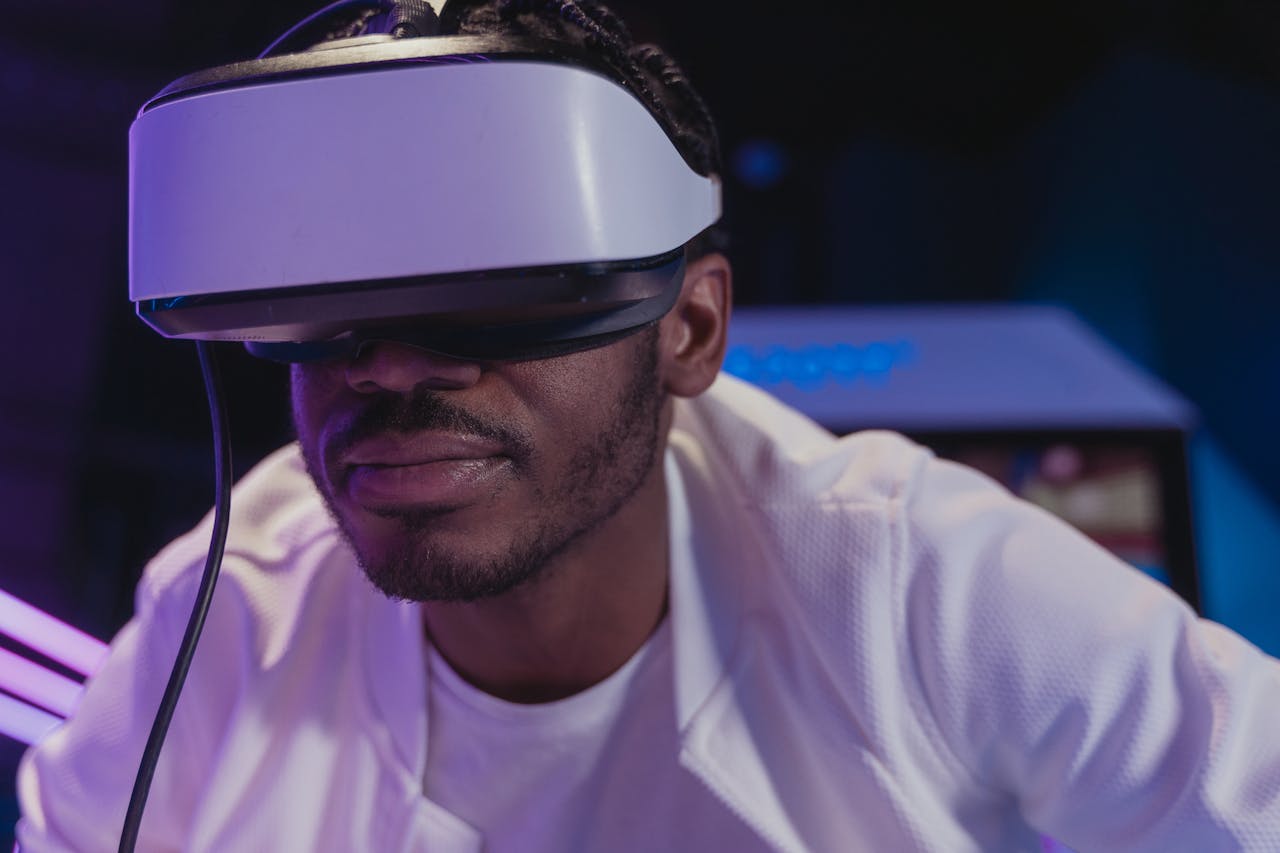
If augmented reality complements the world, virtual reality completely replaces it. VR headsets create the illusion of being in another space, whether it’s a game, simulation, or educational environment. Modern VR devices use complex optical systems to provide a wide field of view and minimize distortion. This makes images more realistic and reduces eye strain. Such technologies are actively used not only in entertainment but also in training pilots, doctors, and other specialists.
Lidars
Lidar (LiDAR) is an optical device that uses lasers to measure distances and create three-dimensional maps of the surrounding environment. It plays a key role in the development of self-driving cars but is also widely used in standard vehicles. With lidars, cars see the road, recognize obstacles, and navigate space. Interestingly, this technology is also used in archeology. Scientists use it to discover ancient cities and artifacts.
Modern Microscopes
Microscopes have come a long way from simple glass curved into a lens to complex systems capable of imaging individual molecules. Modern optical microscopes use lasers, fluorescence, and other methods to produce incredibly detailed images. This is especially important for medicine and biology. Thanks to these devices, scientists can study cells, viruses, and processes occurring within the body, helping develop new drugs and treatments.
New Generation Telescopes
Optical telescopes have also undergone a revolution, and the revolution is not over yet. Modern devices are equipped with adaptive optics, which compensate for the distortions of the Earth’s atmosphere. This allows for images of space to be captured with incredible clarity. Furthermore, space telescopes operating beyond the atmosphere are opening up new horizons, helping to study distant galaxies, exoplanets, and even traces of the early universe.
Smart Cameras
Cameras in smartphones and other devices, despite their miniature size, have long since become complex optical systems. They use multiple lenses, image processing algorithms, and artificial intelligence. Just take a look at Instagram. Today, anyone can feel like a professional photographer simply by taking their phone out of their pocket.
Holographic Technologies
Holography is another rapidly developing field. It enables the creation of three-dimensional images that can be viewed from multiple angles without special glasses. Although fully fledged holographic displays have not yet become widespread, prototypes and commercial solutions already exist for advertising, medicine, and education.
We also highly recommend visiting museums and exhibitions featuring holographic exhibits. It’s a truly amazing and refreshing experience that will captivate you. You might even feel like a character from Star Wars.
Modern research aims to create even more compact and powerful devices. Metamaterials are being developed that allow for the manipulation of light in unusual ways, including invisibility. The integration of optics with other technologies, such as artificial intelligence and quantum computing, is also rapidly advancing. This opens the way to new devices that seem like science fiction today, just as the devices we use today seemed like science fiction a hundred years ago.
Many people don’t even realize how many optical devices they use every day. Light sensors in smartphones, fingerprint scanners and facial recognition systems. All of this is based on optical technologies. These devices make our lives more convenient and safer, operating discreetly yet effectively. They have long been an integral part of our lives.
Modern optical devices are not just tools, but the key to understanding and changing the world around us. They allow us to see the invisible, expand the boundaries of perception, and create new forms of interaction with reality. From microscopes to VR headsets, all these technologies have one thing in common: the human desire to see further, deeper, and wider. And judging by the pace of development, many more amazing discoveries in the world of optics await us.