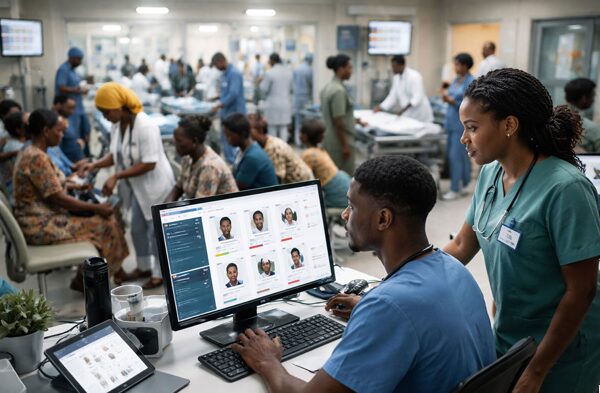
The scene is all too common in public hospitals throughout much of Africa: a state of quiet, weary endurance. In the bustling hallways of Kenyatta National Hospital in Nairobi, or in the crowded waiting rooms of Lagos, the situation is the same: too many patients, not enough doctors, and a system of triage that is being stretched to its limits.
It is important to remember that while healthcare workers are heroes, they are also human. When one nurse is tasked with screening hundreds of people each day, burnout is a very real possibility, and so is a mistake that could cost a life.
This is where the conversation is shifting to technology. But we are not referring to cold technology such as kiosks or medical database systems. We are referring to a much more intuitive solution: AI-native triage.
The Bottleneck at the Front Door
The front door of any public hospital is the triage desk. It’s the gatekeeper. The world has gone digital in many parts of the world for intake systems, but the African public health sector has a lot of manual systems in place. This creates a lag that means that people wait hours just to be told which line to stand in.
The problem is further exacerbated by a brain drain that has seen many skilled medical professionals leave the continent for foreign shores. This has left the continent with a critical shortage of medical staff. The solution does not necessarily lie in creating fewer paper forms; it lies in a way to triage care before a patient even sets foot on the hospital steps.
Integrating Conversational AI for Healthcare
If you’ve ever tried talking to a simple chatbot that wasn’t able to grasp a follow-up question, you might be a bit skeptical. Nevertheless, the new generation of conversational AI for healthcare is a different beast altogether. For a change, these are not simple voice-to-text or translation programs; they’re complex systems that are built to grasp the nuances of a human conversation.
These AI-driven voice agents function as a bridge between complex medical data and actionable insights. Take the tech behind Murf.AI as a prime example. In a triage setting, the system must handle agentic tasks, meaning it doesn’t just read a script; it reasons. If a patient describes a sharp chest pain, the AI understands the intent, identifies the urgency, and responds with a natural, human-like voice that maintains a calm, professional tone. By delivering latency as low as 400ms (Time to First Audio), these agents ensure the conversation feels fluid and reliable, which is critical in an emergency environment.
Why Native AI is the Game Changer
By AI-native, we mean that it is designed for these environments rather than the Western technology that is just tacked on as an afterthought. An AI-native triage system is designed to accommodate the realities of the continent: low bandwidth, different accents, and the integration of local health data.
According to The State of AI in Africa 2025 Report, the goal is leapfrogging. Just as many African nations skipped landlines and went straight to mobile phones, public hospitals are now skipping clunky desktop software for mobile-first, AI-driven triage.
This allows for:
- Instant Sorting: The difference between a cold and a potential case of malaria in a matter of seconds.
- Resource Allocation: The ability to inform hospital administrators exactly how many red-zone cases are on their way.
- Reduced Crowding: A 2025 study found that AI-assisted triage can save patients over 13 minutes of treatment time. That’s a big deal in a crowded ER.
Bridging the Language and Trust Gap
One of the biggest barriers to public health is the language barrier. The current global AI models were developed with English or French as the primary language, with no regard for the thousands of local languages on the continent. AI-native triage is breaking the mold with NLP that recognizes Swahili, Zulu, Yoruba, and Amharic.
When a patient is able to communicate with the system in their mother tongue, it creates a sense of trust. In 2026, we are seeing more projects focus on linguistic inclusion, enabling patients to describe symptoms in their own words. This ensures that advanced diagnostics aren’t just for those who speak a European language.
Support, Not Replacement
The concern that AI will replace doctors is a common one; however, in Africa’s public hospitals, the opposite is true. In these hospitals, AI is a shield. It shields doctors from the white noise that results from sorting. This way, doctors are free to do what they have spent years preparing for: practice medicine.
Think of it as a digital intern that never sleeps or needs coffee. It is a highly efficient intern that works on the repetitive data-heavy work of initial screening. This way, when a doctor finally does get a chance to work on a diagnosis, they are not starting from scratch. They have a head start.
Final Thoughts
The transition won’t happen overnight. It requires investment in digital infrastructure and a commitment from governments to modernize public health frameworks. However, the momentum is undeniable.
Countries like Rwanda, where AI-based triage has already delivered millions of virtual consultations, are proving that this model works at scale.
Ultimately, AI-native triage is about dignity and ensuring that a patient’s first interaction with a hospital isn’t one of exhaustion and confusion, but one of clarity and care. By relieving the pressure on the front door, we give the entire healthcare system room to breathe.